



Who We Are


Guide of the Year


Documents


Charity & SR


Latest Posts


Questions & Answers

Country
Nepal
Kanchenjunga Base Camp Trek is a long and arduous walk in one of Nepal's remote Himalayan off-beat trails. This program from Trek Me Nepal is not your average Himalayan trek. Reaching 8,586 meters, Mt. Kanchenjunga stands as the world's third-highest peak, and reaching its base camps demands both physical mettle and mental strength. For those willing to venture beyond Nepal's well-trodden paths, this trek offers something increasingly rare, a genuine wilderness solitude bundled with unparalleled natural beauty.
The trek encompasses around a hundred and eighty kilometers over a period of three weeks. Unlike the bustling trails of Everest or Annapurna, you'll encounter very few fellow trekkers here. The reason? Restricted Area Permits limit visitor numbers, and reaching there requires a flight to Bhadrapur followed by a rugged drive to Taplejung. There are no shortcuts, no easy entries – just an authentic mountain trek as it was meant to be.
The challenges ahead are numerous. You'll face steep ascents through stone staircases, walk through rugged terrain at a significant altitude, and trek 5 to 6 hours daily through high-altitude landscapes. The climate, too, varies accordingly. In a matter of a few days you will be trekking from subtropical valleys to glacial moraines.
Above the village of Ghunsa village at 3,430 meters, there will be teahouses for overnight stays, with very basic facilities at best. Altitude sickness remains a genuine concern as you ascend gradually on the trail. The thin air, isolation, and demanding terrain test even experienced and returning trekkers to Nepal.
Yet, within this audacity lies the ineffable beauty of a unique expedition. The Kanchenjunga Conservation Area harbours some of Nepal’s most pristine ecosystems. Rhododendron forests explode in crimson blooms each spring; and during the trek you might even spot the elusive snow leopard, red panda, or a Himalayan black bear.
Nepal's national bird Danphe, or the resplendent Impeyan pheasant call this place their home. And since over 250 bird species inhabit these valleys, you definitely hold a high chance of spotting a couple in their unspoiled natural habitat.
On the cultural side, trekkers will witness an equally rewarding scenario. Walking through villages of the Limbu, Rai, and Sherpa, trekkers will glimpse into centuries-old mountain traditions that are largely untouched by signs of modernity. While in Ghunsa, you will see prayer wheels spin beside stone houses and carved wooden frames.
En route, herders will be seen minding their yaks in a manner that has not changed for generations. According to popular belief, the name "Kanchenjunga" translates as "Five Treasures of Snow”; viz gold, silver, grain, gems (or precious stones), and holy scriptures. People who live here among their monasteries, stupas, and mani walls provide a spiritual respite for you along your arduous journey.
Standing at the base of this giant of a mountain and gazing at its colossal faces, you'll understand why locals revere these peaks as sacred to their life. The north face presents a particularly dramatic wall of ice and rock that fills your entire field of vision with humbling immensity.
This program from Trek Me Nepal rewards those who embrace challenges with profound satisfaction. Visiting here in Spring and Autumn are the best time to visit here as clear skies and moderate temperature will favour the trekkers. Spring brings blooming flowers (especially rhododendrons or ‘gurans’) and Autumn will be suitable for crystalline mountain views.
The bucolic beauty of Nepal's eastern peaks, combined with the accomplishment of reaching the base camp, is a feat no less. The cultural encounters and those rare moments of complete silence – these become memories that resonate long after you've descended. This program is undoubtedly for seasoned trekkers who seek authentic Himalayan adventure beyond the crowds.
Note: If you're drawn to remote Himalayan trekking, also consider our Saipal Base Camp Trek
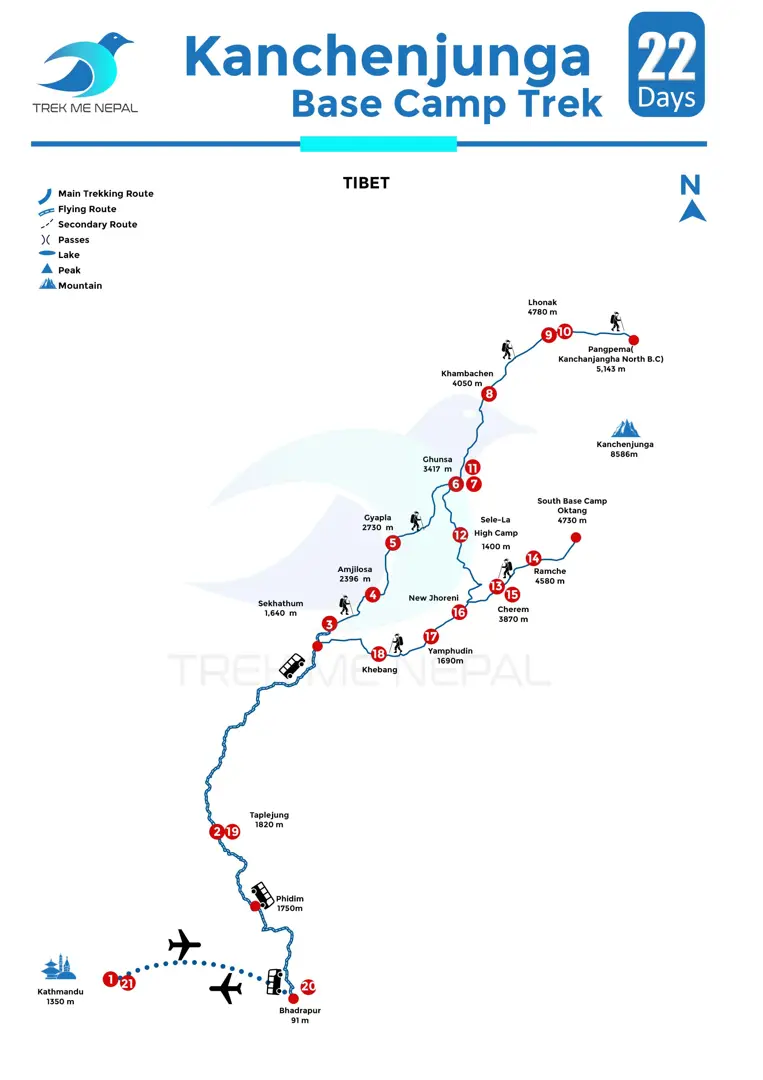
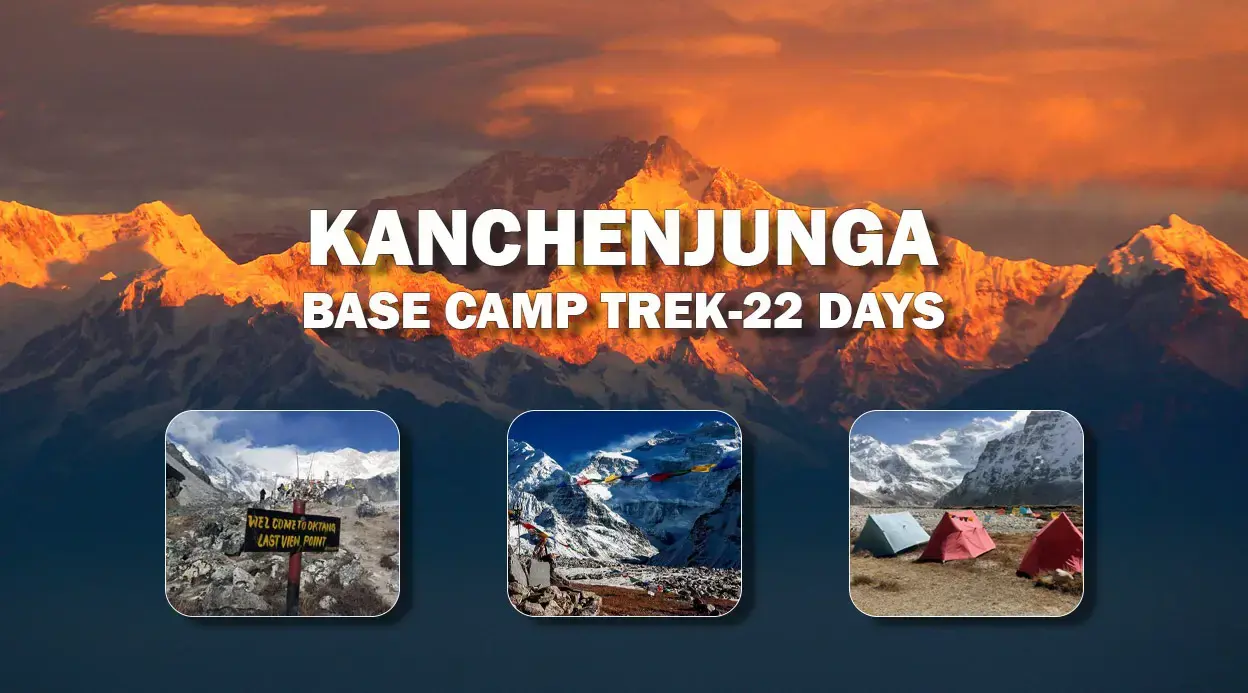
Trek through remote eastern Nepal to Kanchenjunga Base Camps, crossing alpine forests, mountain villages, glaciers, and high Himalayan passes in 22 adventurous days.
Once you arrive at Tribhuwan International Airport, you'll be received by our staff and transported to your hotel. After some rest and refreshments, we'll provide you with a brief about your upcoming Kanchenjunga Base Camp trek before heading on your epic mountain adventure the following day.
Begin your journey with an early morning flight from Kathmandu to Bhadrapur, a scenic 45 to 55-minute trip offering sweeping Himalayan views. Upon arrival at Bhadrapur (aka Chandragadhi) Airport, drive 6 to 8 hours north toward Taplejung, the gateway to the Kanchenjunga region.
The route winds through lush hills, vibrant villages, and the tea gardens of Ilam, revealing glimpses of rural life and terraced landscapes. Reach Taplejung by evening, where you can rest, enjoy a warm meal, and prepare for the adventure ahead.
After breakfast in Taplejung, set out on a thrilling 5-hour off-road jeep ride to Sekhathum, following the winding Tamor River. The route passes through villages like Mitlung, Chirwa, and Lelep, offering glimpses of terraced fields, waterfalls, and everyday mountain life.
Expect bumpy sections, especially beyond Ranipul, adding to the adventure. En route, permits are checked at the Kanchenjunga Conservation Area entry point. Reaching Sekhathum at around 1,640 meters, near a river confluence, marks the start of the trekking trail.
Today marks the start of your trek from Sekhathum to Amjilosa, following the scenic Ghunsa River. After breakfast, cross a suspension bridge and begin a steady hike through lush rhododendron and bamboo forests.
The trail undulates with several ups and downs, passing small settlements like Solima, with lunch typically at Lamatar after 3.5-4 hours. The final 1.5-2 hours involve a steeper ascent, making for a rewarding challenge.
Arriving in Amjilosa, a quiet village of Sherpa and Tibetan communities, you’ll settle into a basic lodge and rest for the night.
Today’s trek from Amjilosa to Gyapla follows the lush valley of the Ghunsa Khola. The trail winds through dense bamboo, oak, and rhododendron forests, with waterfalls cascading from steep cliffs. After about 3 hours, reach Thangem—a quiet forest clearing—perfect for a lunch break.
The journey then continues for another 2 hours through remote jungle paths, with a mix of gentle stretches and steady climbs. Arrive at Gyapla, a peaceful settlement with simple teahouses, where you can relax or take a short side trip to Upper Gyapla for wider mountain views.
Leave Gyapla and follow the Ghunsa Khola through lush rhododendron and fir forests. Pass a traditional stone gate before reaching Pholay, a small Tibetan-influenced settlement where legends warn against taking pigs beyond. Stop here for a relaxing lunch amid chortens and spiritual stories.
The trail continues for one and a half to two hours, weaving through jungle paths, waterfalls, and yak pastures. Arrive in Ghunsa, a serene Sherpa village framed by towering peaks, prayer flags, and monasteries. Take time to explore, spin prayer wheels, and enjoy the warm mountain hospitality.
Today, you will take a well-earned day of rest in Ghunsa whose name means “House of Snow” (Guin meaning ‘Snow’ and Sa meaning ‘Location’) in the local dialect. The meaning is akin to the geographical word for a low-lying area in the high-altitude mountains, much like “Bensi” in Nepali.
At 3,430 meters, this day of acclimatization helps your body adapt to higher altitudes. You can spend the day with a gentle hike to the nearby Laspsan-La Monastery amid the serene mountains. Return to Ghunsa for walks, meet friendly Sherpa families, and learn about local traditions.
Light activity combined with cultural immersion will certainly be refreshing, and the acclimatization will prepare you for the more challenging trek ahead.
Early in the morning, you will set out from Ghunsa headed toward Khambachen. It is approximately a five-hour walk reaching an altitude of around 4,100 m). You will be following the river and also through larch and juniper forests, yak pastures, and scattered hamlets of Sypchen and Tartang.
You will cross sandy, boulder-strewn banks and a wooden bridge at Rampuk Kharka (at around 3,700 m). From here, the trail enters landslide-prone sections, where care and steady footing are essential. Later on, the valley opens up dramatically, revealing glaciers and peaks, including Mount Jannu to the right and at least three other peaks to the left.
Along the way, traces of traditional ‘Khamba’ (homes) and ‘Chen’ (courtyards) remain, from where Khambachen got its name. This alpine village, set among glacial junctions, has teahouses where you can rest for the night.
Today’s trek is approximately five hours. Leaving Khambachen behind, your trail to Lhonak enters a stark wilderness of moraines, boulders, and exposed slopes. The path is demanding and at times landslide-prone, requiring careful footing.
You will find a breather here at Ramtang Kharka (around 4,350 m), you can have tea or noodle soup in a basic teahouse. Moving forward from here, the route follows a river for another two hours, passing glacier junctions and widening valleys.
Sweeping Himalayan views will certainly refresh you, including distant peaks like Mera Peak. Located beside a glacial river, Lhonak itself is a tiny windswept outpost with basic teahouses on a vast glacial plain beneath towering mountains. Here you’ll stop for the night.
Today you’ll be reaching the Base Camp. In a rewarding trek, you reach Pangpema (Kanchanjangha North Base Camp) and back, covering about 15–16 km in roughly nine hours. The trail follows more of the glacial moraines and rocky terrain, with sections prone to landslides.
Careful footing is essential here in a landscape, where vegetation is sparse with mostly thin grassland. As you approach Pangpema (5,143 m), the towering north face of Mount Kanchenjunga will be seen dominating the horizon. Views of Mt. Jannu and other surrounding peaks will be seen looming above.
Prayer flags will be seen fluttering in the wind with vast glaciers stretching into the distance. After an hour of soaking in the beauty, you gradually return to Lhonak for an overnight stay. Unforgettable scenery will be etched in your memories of this remote high-altitude location.
In today’s trek, you will trek down from Lhonak in a long but rewarding return journey to Ghunsa, taking about 9 hours. Retracing your steps after visiting the base camp, the familiar trail reveals fresh perspectives of the Himalayas, with sweeping views and the striking presence of Mt. Jannu gradually fading behind.
You will be descending nearly 1,350 metres over rocky moraine and glacial paths. The trek is steady today, but very demanding on the knees. Passing through Lhonak and Kambachen, the landscape shifts from stark alpine terrain to greener surroundings.
By afternoon, you will reach Ghunsa, where warm food and a bed will be waiting. Sleep is guaranteed tonight as is a well-earned and comforting stay.
Starting off from Ghunsa, you begin a steady five-hour ascent toward Sele-La Camp (~4,300 m), a remote high-altitude stop in Faktanglung Remote Development Committee. The trail climbs through dense forests of pine, birch, and rhododendron before opening up to alpine meadows.
This less-trodden route feels wild and exceptionally quiet, with a chance to spot Himalayan wildlife such as musk deer, thar, or even a red panda. As you climb higher, the forest begins to thin but the views expand to dramatic Himalayan panoramas. On clear days, you’ll have no problem seeing Kanchanjangha and Mt. Jannu.
At Faktanglung, a sacred boulder stands as a revered landmark linked to the heritage of the Limbu. Few teahouses operate here in season. Further up, you will spend the night in a basic teahouse, surrounded by awesome mountainous beauty.
Begin the trek early from Sele-La as you head out on a long and rewarding day toward Cherem. Today you will be crossing three passes namely Sele-La, Mirgin-La, and Sinon-La. The trail is rugged, undulating, and often exposed, so carrying a packed lunch is essential.
As you climb above the tree line, sweeping views of the peaks unfold. Kanchenjunga, Jannu, Makalu, and surrounding peaks will be visible, with prayer flags marking the windswept passes. Trekking along ridge-lines and barren alpine terrain, a steep descent of about two hours will bring you to the hamlet of Cherem.
Located beside a river, this remote settlement has a quiet ambience. Stay here for the night in a very basic teahouse.
Starting from Cherem, you will set out on a short but rewarding trek to Ramche taking about 3 to 4 hours. Begin with a steep climb up to Aloo Bari (literally “potato field”) before the trail eases into a steady ascent.
Following the river along the edge of the Yalung Glacier your route will pass through alpine meadows and rocky terrain. Increasingly expansive views of the surrounding peaks such as Kabru and Rathong will be welcome additions. As you gain height, you might notice the thin mountain air, but the scenery makes the effort worthwhile.
Reaching Ramche, you will see that it is a small hamlet settled only in season by yak herders. Stay in this peaceful location in a basic teahouse for the night.
Starting off early from Ramche, you will set out on a rewarding trek to Oktang, the Southern Base Camp of Kanchenjunga. From there you will be returning to Cherem, with the day’s total journey coming to about six hours at a relaxed pace. The trail follows the Yalung Glacier, gradually ascending through alpine terrain and rocky fields.
As you approach Oktang, the views become truly spectacular, with Kanchenjunga's towering south face rising dramatically alongside peaks like Kabru and Rathong. After photographing and spending time soaking in the scenery from this iconic viewpoint, you will return to Ramche.
The descent is gentle and scenic, leading back to Cherem where you will be sleeping for the night in a teahouse.
After a quick breakfast, you will set off from Cherem for a long day’s trek to New Jhoreni located near a small lake (around eight hours with stops). Starting with a steep descent of about 4.5 hours to Torongdin, you will pause for lunch. The trail then continues downhill before a gradual climb leads you to New Jhoreni.
Today you will be losing altitude, noted by the landscape that transforms from alpine terrain to dense forests of rhododendron and pine. The sound of gushing rivers will be heard at sections of the walk.
Along the way, glimpses of peaks appear behind you, offering a final look at the high Himalayas of the Kanchenjunga region. By evening, you will reach New Jhoreni, a quiet stop with a teahouse where you’ll stretch your legs and sleep tonight.
Early morning from New Jhoreni, you begin the descent steadily toward Yamphudin, following forested trails down to the Amjikhola valley. The route winds through dense rhododendron, pine, and bamboo forests, with occasional landslide-prone sections that demand care and attention while walking.
As you further lose altitude, the air begins to grow warmer and the landscape softens into terraced fields and small settlements. From there you will cross streams and ridge-lines, while enjoying a mix of gentle ups and downs before opening into cultivated farmland.
By afternoon, you will arrive at Yamphudin, a lively village with a mix of local communities. Here, a basic but comfortable teahouse will be welcoming amid the hilly atmosphere. Bask in a well-deserved and relaxing evening to end the day’s trek.
Start after a leisurely breakfast from Yamphudin. You will follow a dusty vehicle track headed towards Khebang. The trek takes around 5 to 5 and a half hours on foot. The trail winds through terraced fields, scattered villages, and patches of forest, offering a closer look at everyday rural life in the hills of eastern Nepal.
Compared to the high mountain tracks you just traversed in the past two weeks, the terrain here feels gentler and more settled. Although the road can be dry and dusty at times, along the way you may pass locals going about their daily routines and occasional livestock moving along the track.
By afternoon, you will reach Khebang, where a simple teahouse or a lodge provides a comfortable place to rest after the day’s trek.
Starting off from Khebang, you will continue your journey toward Fikkal, gradually leaving the trekking trail behind. As you descend into the greener mid-hills, your route will pass through a mix of village paths and rough roads, through terraced fields, cardamom plantations, and scattered settlements.
Here you can witness daily rural life as it unfolds right before your eyes. By this point you will have lost a significant amount of altitude. You will notice the landscape becoming warmer and more cultivated, with forests giving way to farmland and tea-growing regions.
These are the world-renowned tea-plantations of Illam itself. Enjoy the views as you come to the final stretch of your trek. By the end of the day, you reach Fikkal, a lively hill town known for its tea gardens, where a comfortable stay in a lodge marks a gentle return to civilization for the first time in three weeks.
After a leisurely breakfast in Fikkal amid the greenery, you will drive down to Bhadrapur, a journey of about 2.5 to 3 hours, passing through tea gardens, hillside villages, and gradually descending from cool hills to the warm plains of eastern Nepal.
The road is mostly black-topped, offering a comfortable ride as the landscape shifts noticeably in climate and scenery. Upon arriving in the town of Birtamod, you will have a quick break and refreshment. From here you will have a 45-minute scenic drive to Bhadrapur Airport where you’ll board a short 45-minute flight to Kathmandu.
On a clear day, the flight offers distant views of the Himalayan range, where you can have one last glimpse of the mountains this time. After landing in Kathmandu, you transfer to your hotel, where you can relax and unwind, marking the end of your trek to Kanchenjunga.
We keep a reserve day for the sake of emergencies. In case that your trek has to be postponed due to bad weather or delays because of health, physical weakness, or injury, it is customary to set aside a day of contingency, especially during multiple-week treks. If things go as planned, you will shorten a day in your itinerary.
Since the weather at high altitudes cannot be predicted, it is customary to set aside an extra day. If there are no unexpected reasons, the trip will go smoothly as planned.
After breakfast or depending upon your flight schedule we will transfer you to the airport. As your plane takes off from the runway in Kathmandu, your journey to Nepal comes to an end for this time — until you decide to visit again for some memorable and soul-searching trip in the Himalayas.
Whats Included:
Whats Excluded:
$ per person
(Price Varies by Group Size)
No departures available at the moment.
Best Picks for Travelers

Moderate
Annapurna Region
/ person
Moderate
Annapurna Region
/ person
Moderate
Everest Region
/ person

Challenging
Everest Region
/ person
Challenging
Everest Region
/ person
Other Trips from Everest Region in Nepal
Moderate
Everest Region
/ person
Challenging
Everest Region
/ person

Moderate
Everest Region
/ person


Challenging
Everest Region
/ person

Challenging
Everest Region
/ person


More Reasons Why Travellers Trust Us