






Who We Are

Guide of the Year


Documents


Charity & SR


Latest Posts


Questions & Answers

The Yartung Festival is a traditional Tibetan Buddhist festival celebrated in Upper Mustang, Nepal. It takes place over three days, typically around the full moon in August.
In locations such as Lo Manthang and Muktinath, locals gather for communal activities that include horse riding, cultural dances, and singing traditional songs.
The festival begins with a procession led by monks to an open field, followed by events where participants, dressed in traditional attire, engage in games and feasts.
For travelers visiting Upper Mustang, this provides a direct view into the region's preserved Tibetan-influenced lifestyle, with opportunities to observe daily routines in remote villages surrounded by Himalayan landscapes.
| Aspect | Details |
| Package Type | Guided group trek with fixed itinerary centered on the Yartung Festival. |
| Core Experience | Guaranteed attendance at the Yartung Festival in Lo Manthang to witness horse races, archery, and rituals. |
| Key Inclusions | • Licensed guide & porter services • All meals during the trek • Teahouse accommodation • All required permits (RAP & ACAP) • Domestic flights (Pokhara-Jomsom) / land transport |
| Booking Requirement | Mandatory advance booking through Trek Me Nepal. Independent travel is not permitted for the restricted area. |
| Critical Permits | Upper Mustang RAP ($500/10 days) & Annapurna Conservation Area Permit (ACAP). Arranged by the company. |
| Recommended Booking Time | Several months in advance due to strict permit quotas and limited lodging. |
The Yartung Festival has a lot of significance in Mustang culture as a Tibetan festival that strengthens community ties and preserves historical practices.
For locals, including the Loba people of Upper Mustang, it serves as a time for relaxation and celebration after agricultural work, allowing families to come together for blessings from monks and village elders.
Traditions such as horse racing, where riders demonstrate skills like scooping scarves from the ground or performing feats while mounted, highlight the practical role of horses in transportation and trade.
Archery competitions and monastery rituals, including prayers and offerings at sites like local gompas, add a spiritual layer, blending Buddhism with daily life.
For tourists, the festival offers insight into Nepal's Himalayan cultural festivals, attracting visitors to experience authentic interactions, view ancient monasteries, and join in the communal atmosphere, contributing to the region's tourism growth.
For more information on Major Festivals, Culture and Tradition in Manaslu Region, check out our blog here.
The Yartung Festival history traces back over a thousand years to the earliest human settlements in Upper Mustang, Nepal, which was formerly known as the Kingdom of Lo and remained a restricted area until 1992.
This traditional festival reflects Mustang heritage through its roots in ancient Tibetan-influenced practices of the Lo region, including the 500-year-old walled city of Lo Manthang and surrounding areas like Lo Manthang, Salome, and Baragung Muktichhetra rural municipalities in Gandaki Province.
The name Yartung Festival Nepal derives from Tibetan words, where "Yar" means summer and "Tung" means farewell or let it, symbolizing the end of the summer season after the harvest.
Historical accounts from locals indicate that the Yartung festival Mustang began during the era of small divided states in the region, when early kings and communities celebrated victories and territorial expansions by gathering for worship, horse races, and archery competitions.
Anecdotes passed down through generations describe grandfathers recounting how victorious parties would ride horses to mark their wins, evolving into a structured event that has been maintained annually to honor past successes and provide entertainment for farmers after the agricultural season.
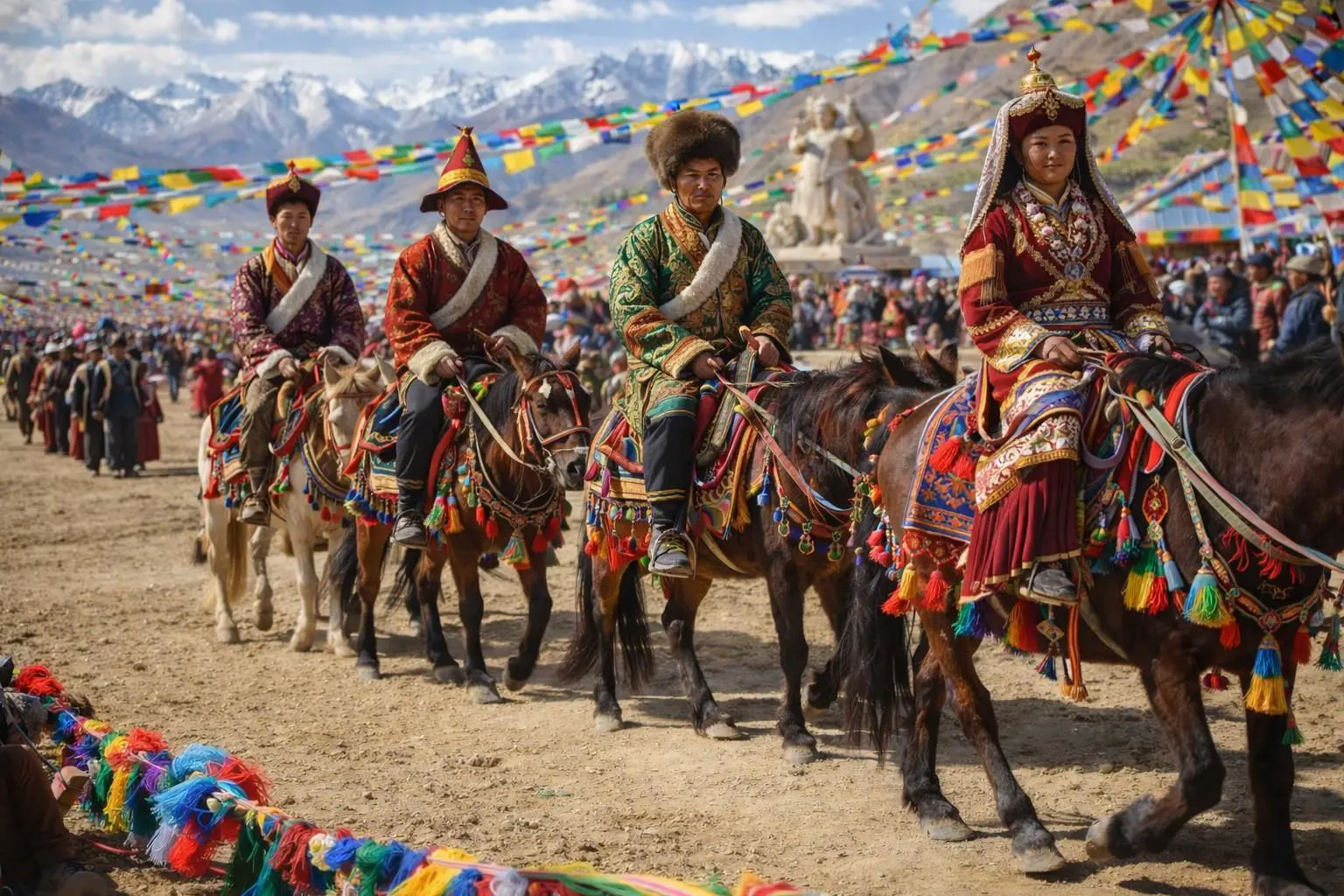
Horse racing and local traditions have been preserved over centuries due to the region's isolation, which protected Tibetan culture, Tibetic dialects, and the integral role of horses in daily life for transportation, trade, and as symbols of status and wealth, with each household typically owning at least one horse treated as a family member.
The Yartung Festival brings together the Loba people and other groups like Thakali and Gurung in Lo Manthang culture for a three-to-five-day event typically held around the full moon in August, coinciding with Janai Purnima.
Cultural practices include prayers and rituals performed in monasteries, such as contributions and offerings to Buddha, followed by blessings from lamas, monks, the local king or prince, village elders, and senior residents for prosperity in the coming year.
The senior Lama determines the auspicious date based on calculations, often after crop gathering is complete.
Dances form a key part of the festivities, with cultural dances and shows organized in groups by Thakali and Tibetan people, including traditional Loba songs and melodies performed across open fields during the first few days dedicated to merrymaking.
Rituals begin with a procession led by monks to an empty field on the outskirts of Lo Manthang or to locations like Khimkar near Muktinath, Jharkot, and Ranipauwa, where puja ceremonies take place at local gompas (monasteries) on the final day, involving worship to revive faith and energy.
Local costumes consist of traditional attire such as Bakkhu, Bhure, and Chhatretop worn by participants, along with vibrant outfits that enhance the visual aspects of the celebrations.
Music involves local melodies accompanying the dances and communal activities, while community participation is extensive, encompassing locals, lamas, monks, the royal entourage, riders from Mustang and nearby districts like Manang (including villages such as Pisang, Nangwal, Khangsar, and Bhakra), and even tourists.
The event fosters unity through shared activities like feasting under tents with chang (wheat wine), singing, and group performances, with the last two days focused on worship at decorated gompas.
This Himalayan cultural festival maintains its ancient Tibetan festivals Nepal essence through annual observance tied to harvest cycles, allowing young men and women aged 16 to 60 from various villages to demonstrate skills in traditional games, while the broader Yartung festival traditions emphasize relaxation, social bonding, and the preservation of Yartung festival culture in this isolated region.
| Main Activity/Event | Brief Description and Key Details |
| Horse Racing | The festival's main event. Local riders race on traditional Mustang horses at high speed, showcasing incredible skill. The races symbolize the historic bond between the people and their horses. Crowds cheer, creating an electric atmosphere. |
| Archery Contests | Traditional archery competitions are held alongside the races. Participants use handmade bamboo bows, wearing traditional dress. It's a test of precision and a celebration of ancient martial skills. |
| Other Traditional Games | Includes local competitions like stone throwing or horse-mounted skill games. These activities highlight strength, agility, and centuries-old pastoral traditions unique to the region. |
| Religious Ceremonies | Monks from local monasteries (like in Lo Manthang) lead prayers and rituals. Key ceremonies include the blessing of horses and riders for safety, and offerings for community prosperity. |
| Blessing of the Horses | A specific ritual where monks bless each horse before the race. They sprinkle holy water and recite prayers for the animals' strength and the riders' safety, blending spirituality with sport. |
Horse racing is the central event of the Yartung Festival. Riders compete on sturdy Tibetan ponies across open fields, often in locations like Lo Manthang or Ranipauwa in Upper Mustang.
The races typically span a distance such as a five-kilometer dirt track from Chher Thanga to Ranipuawa Purang, starting around 10:00 am and continuing until late noon.
Participants, usually aged 16 to 60 and including both men and women from districts like Mustang and Manang (villages such as Pisang, Nangwal, Khangsar, and Bhakra), ride at full speed to demonstrate skills.
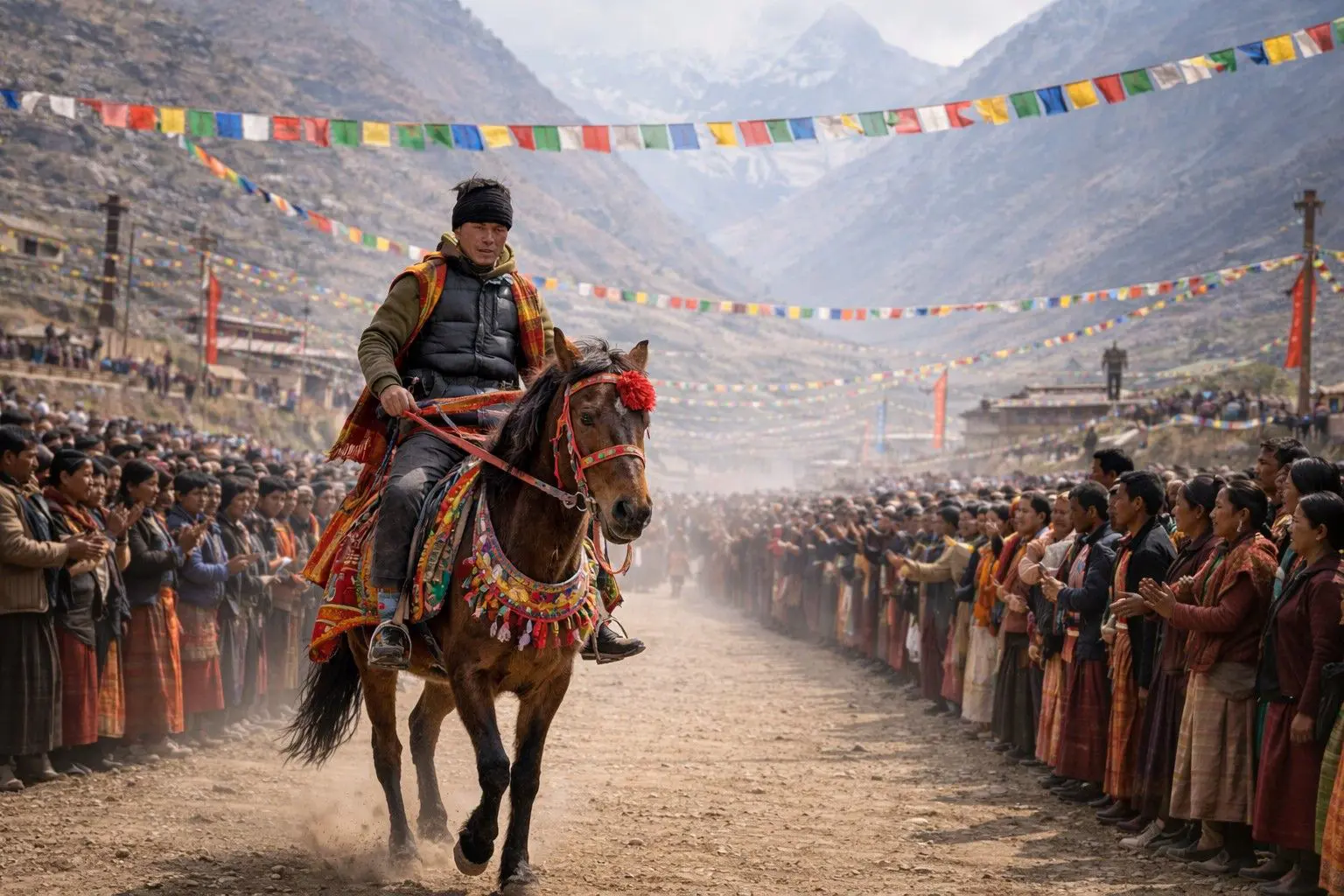
Rules participants have to follow include structured competitions where riders perform feats like scooping khatas (Tibetan blessing scarves) from the ground while galloping, throwing rocks at stationary targets, or hanging from the horse with one leg on the saddle and the other dragging on the ground.
Traditions divide the event by days: the first day focuses on men's races, the second on women's races (sometimes including mixed men vs. women events), and the third opens to all or features monks.
Horses are prepared by allowing them to run freely for four to five months beforehand, then adorned with colorful ribbons, ornaments, and intricately woven decorative blankets during the festival.
Sensory details like the sound of charging hooves on rugged Himalayan terrains, crowd cheers from villagers and tourists, and visual elements like riders in traditional attire such as Bakkhu, Bhure, and Chhatretop amid snow-clad mountains and grasslands can also be observed.
This tradition highlights the cultural significance of horse racing in Mustang, as horses serve as essential for transportation, trade, and symbols of status, with each household owning at least one, which is treated as a family member.
Archery contest is a key part of the Yartung festival activities. Archery competitions involve participants throwing arrows at targets, often integrated into the festival's sequence, with events starting on the second day and results announced alongside other games.
Rules are straightforward, focusing on precision and skill, where winners are declared based on accuracy. Other competitions include football matches between surrounding villages, stone throwing at stationary targets (sometimes during horse rides), tug of war, and gambling under tents.
These Mustang traditional sports occur across the three to five days, with the first few days dedicated to group activities like cultural dances performed by Thakali and Tibetan people, singing traditional Loba songs and melodies, and folk dances in colorful clothes and masks.
The uniqueness of the festival is in blending physical contests with social elements, where young men and women aged 16 to 60 from various villages demonstrate bravery and camaraderie without formal prizes, emphasizing participation over competition.
Monastery rituals form an essential spiritual component of the Yartung Festival, incorporating Mustang festival worship and Tibetan Buddhist rituals Mustang.
The festival begins with a short ceremony inside the walled city of Lo Manthang or a procession led by monks to an empty field on the outskirts, such as near Khimkar, Jharkot, or Ranipauwa.
Rituals include offerings and contributions to Buddha, performed by lamas, monks, the local king or prince, village elders, and senior residents, seeking blessings for prosperity, protection from evil spirits, and a successful year ahead.
The senior Lama selects the auspicious date based on the Tibetan lunar calendar, typically aligning with the full moon in August (Janai Purnima), after harvest completion.
Specific practices involve pujas (prayer ceremonies) at local gompas (monasteries), where participants cry out “Lhagyal Lo” to call protective deities, replace prayer flags, and lead an 'empty' horse riderless for the deities.
The structure dedicates days to spiritual focus: the first day to the village head or king's activities, the second to monks, and the third to broader worship, concluding with blessings and offerings at sites like Muktinath Temple.
Other details include the sounds of chanting, prayers, and traditional drums during ceremonies, along with visual elements like decorated gompas and participants in ancestral clothes.
These rituals can be educational for travelers, illustrating the blend of Buddhist and Hindu elements in the region, such as in Muktinath as a pilgrimage site.
The festival is primarily celebrated in the ancient walled city of Lo Manthang, the cultural heart of Upper Mustang.
Key events also occur in nearby villages like Tsarang and Ghami along the main trekking route. The area is accessible via a scenic multi-day trek from Jomsom.
| Location | Type of Place | Key Festival Activities and Notes |
| Lo Manthang | Ancient Walled Capital City | The primary venue. Hosts the main horse races, archery contests, and the most elaborate monastery rituals inside its historic walls. |
| Tsarang (Charang) | Village (South of Lo Manthang) | Often features preliminary races or local celebrations. Known for its red Tsarang Gompa monastery and ruins. |
| Ghami | Village (Along the Trekking Route) | A common stop where smaller-scale events or welcome ceremonies may occur. Famous for its long Mani wall. |
| Samar | Scenic Village (Trekking Route) | Not a major event site, but a key acclimatization stop on the journey to the main festival areas. |
| Jomsom | Gateway Town (Airport) | Not a festival site. This is the main travel hub where treks/flights to Upper Mustang begin and end. |
| Muktinath (Ranipauwa) | Pilgrimage Site | Some years, related celebrations or a smaller version of the festival occur here, blending Hindu and Buddhist traditions. |
The Yartung Festival date falls annually in August, tied to the Tibetan lunar calendar and typically aligning with the full moon day known as Janai Purnima. The festival event lasts three days, marking the end of summer after harvest completion.
For 2026, celebrations in Lo Manthang occur on 17, 18, and 19 August. In other areas like Ranipauwa Muktinath, events may extend to four or five days around the same period.
The exact dates are confirmed by local lamas based on auspicious calculations. Travelers plan visits to arrive before the main days for setup and processions, avoiding peak crowds by starting early in the month while ensuring presence for the full duration of horse races and rituals.
| Recommended Month | Details |
| Recommended Month | August (during the festival dates) |
| Average Daytime Temperature | 15°C to 20°C (59°F to 68°F) |
| Average Nighttime Temperature | 5°C to 10°C (41°F to 50°F) |
| Weather Conditions | Generally stable, clear skies, and minimal rainfall. Strong sun at high altitude. |
Plan your visit for the middle of the festival period for the most activities.
Arriving a day early helps with acclimatization and securing a good viewing spot. The weather in August is generally clear and mild, ideal for trekking.
Trek Me Nepal can tailor trekking packages for the Yartung Festival tour, combining the Upper Mustang trek with direct participation in Yartung festival.
These options follow established routes through arid valleys and high passes, starting typically from Jomsom after a flight from Pokhara, and leading to key sites such as Lo Manthang and surrounding villages.
The packages emphasize scenic routes along the Kali Gandaki Valley, passing ancient monasteries, caves, and traditional settlements, while timing arrivals to coincide with the three-day festival events including horse racing and rituals.
Travelers experience cultural immersion through stays in local teahouses, interactions with Loba communities, and observation of daily Tibetan-influenced lifestyles in this restricted region.
Access to Upper Mustang involves options by air, road, or trekking.
Common routes include flights from Kathmandu to Pokhara, followed by a short flight to Jomsom, then onward trekking or jeep travel through Kagbeni as the entry gateway. Road access extends via drives from Pokhara or Beni, though conditions vary with weather.
An Upper Mustang entry permit is required as a Restricted Area Permit, along with the Annapurna Conservation Area Permit (ACAP).
| Permit Name | Cost (Approx.) | Where to Obtain | Needed For | Notes |
| Upper Mustang Restricted Area Permit (RAP) | USD $500 for the first 10 days, then $50/day. | Through a registered Nepali trekking agency. | All foreign travelers. | Cannot be obtained independently. This is the primary, mandatory permit for the region. Your agency handles the application. |
| Annapurna Conservation Area Permit (ACAP) | NPR 3,000 (approx. USD $23) | Nepal Tourism Board in Kathmandu/Pokhara, or through your trekking agency. | All trekkers. | Standard entry permit for the Annapurna Conservation Area, which you pass through to reach Mustang. |
Tips our guides give for participants include maintaining moderate fitness levels for daily walks of 5-7 hours on rugged terrain, building cardiovascular stamina beforehand, and allowing time for acclimatization to altitudes up to 4,200 meters to reduce risks of altitude-related issues.
Stay hydrated, follow paced itineraries with built-in rest days, and consult on health preparations.
During the Yartung Festival, locals serve traditional Mustang dishes and drinks that reflect the region's Tibetan-influenced culture. Common items include chang (a local alcoholic beverage made from fermented wheat or barley), butter tea (salty tea mixed with yak butter), and homemade alcohol distilled in copper pots.
Other foods available at stalls or gatherings consist of rice mixed with cow ghee, potato-based dishes, noodle soups such as thukpa, steamed dumplings known as momos, and Tibetan bread.
Festival food Upper Mustang also features seasonal vegetables, soups, and rice or noodle preparations shared during communal meals. Tourists can try these at open fields or tents, where aromas from cooking fill the air and tastes provide warmth in the high-altitude environment.
Recommendations include trying Chang for its mild fermented flavor, butter tea for energy, and momos filled with vegetables or meat, all prepared using local ingredients suited to the arid climate.
During the Yartung Festival, local families from Upper Mustang and neighboring areas like Manang set up temporary tent camps in open fields. These camps, often placed outside Lo Manthang or near Ranipauwa Muktinath, become the social center for the entire 3-5 day event.
Everyone gathers here: locals, monks, horse riders, and visitors. The main activities are simple: sharing meals, drinking local beverages like chang, and talking.
Traditional music and dances are performed throughout the day and night. The atmosphere is relaxed and communal, reflecting the festival's role as a post-harvest celebration.
Tourists are welcome to join these gatherings. It is a direct way to experience local hospitality and daily social life, not just the scheduled festival events.
| Aspect | What You Will Experience |
| Unique Cultural Access | Direct, rare access to the ancient, preserved Tibetan culture of Upper Mustang, a region closed to outsiders until 1992. |
| Main Festival Highlights | • Thrilling Horse Races: Riders perform skilled stunts (like scooping khatas) on decorated Tibetan ponies. • Traditional Performances: Local groups perform songs and dances in vibrant traditional attire. • Monastery Rituals: Monks conduct pujas, blessings, and ceremonies in ancient gompas. |
| Structured Schedule | The 3-day event is organized, with dedicated days for: men's races, women's events, and monks' rituals. |
| Stunning Setting | Events take place in open fields against a backdrop of arid canyons, cave shrines, and Himalayan peaks. |
| Cultural Immersion | Opportunity to interact with the Loba community, join communal feasts, and witness century-old post-harvest celebrations. |
Trek Me Nepal offers several packages for Upper Mustang Region which can be designed for attending the Yartung Festival.
The tours are typically guided group treks. The core experience is built around arriving in Lo Manthang to coincide with the festival dates. The itinerary includes dedicated time to observe the main events: horse racing, archery contests, and monastery rituals.
The package price is inclusive. It covers necessary logistical components for the trek and festival attendance.
Package Inclusions (Standard)
While booking, please mention and confirm your participation for a specific festival date group in advance due to limited permits and accommodations. We advise you to book several months ahead.
You will need to provide standard travel details and documentation for the permit applications. We handle the application process for the required government permits on your behalf, which is a mandatory step for this restricted region.
Check out recent travel trends and news by Trek me Nepal


More Reasons Why Travellers Trust Us




Bibek Thapa
Content Writer & Social Media OfficerBibek Thapa is currently pursuing his Bachelor's in Travel and Tourism Management (BTTM) at the National Academy of Travel and Hotel Management (NATHM). His academic background in tourism, combined wi... Read More