





Who We Are

Guide of the Year


Documents


Charity & SR


Latest Posts


Questions & Answers

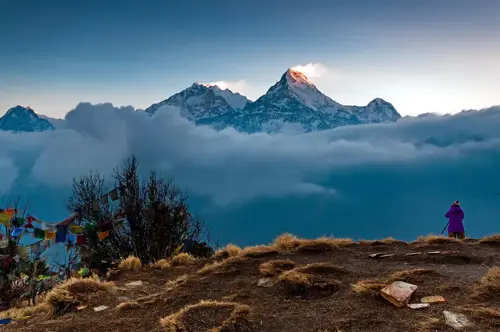
Yes — but only on the right routes. Rain shadow areas like Upper Mustang, Dolpo, and Tsum Valley stay dry while the rest of Nepal gets drenched. This guide covers exactly which trails work in June, July, and August, what to pack, and how to save 30–40% on packages in the off-season.
Every travel blog, every guidebook, every forum post tells you the same thing: don't trek Nepal during monsoon. Avoid June through August. Wait for autumn.
I disagree — and I say that as someone who has spent the last decade guiding treks through these mountains every month of the year, including the wettest ones.
Here is the truth most agencies won't tell you: some of Nepal's finest trekking happens between June and September, if you know exactly where to go. The key word is where. Not every trail is safe during monsoon. Some are genuinely dangerous. But others — tucked behind the Himalayan rain shadow — receive less rainfall during the entire monsoon than London does in an average summer.
This is my honest breakdown of which trails work, which don't, and what to expect if you choose to trek Nepal during the off-season.
Most people picture monsoon as non-stop torrential rain from dawn to dusk. That is not how it works in Nepal. The typical daily pattern looks like this:
Time of Day | What to Expect |
5 am – 10 am | Clear skies, often brilliantly clear. Some of the best mountain views of the year happen at dawn during monsoon — the air has been washed clean overnight. |
10 am – 2 pm | Clouds start building from the south. Humidity rises. Good time to be on trail and moving. |
2 pm – 8 pm | Rain arrives, sometimes heavy. Thunder and lightning common in the hills. Plan to be at your lodge. |
Night | Rain tapers off, air cools. Perfect sleeping conditions. |
In the rain shadow zones north of the Himalayan range, even this pattern barely applies. Upper Mustang receives under 200 mm of rain per year — comparable to a semi-arid desert — because the high mountain wall blocks incoming clouds from the Bay of Bengal. Best Places to Trek in Nepal During Monsoon (June–September)
The Himalayas act as a wall that blocks monsoon clouds from crossing north. Everything south of this wall gets drenched. Everything north stays dry. This creates a completely different trekking reality in June, July, and August.
Region | Monsoon Rainfall | Best For | Difficulty | Permit Cost | Best Months |
Upper Mustang | Under 200 mm/yr | Culture + views | Moderate | USD 500 (10 days) | June – Aug |
Upper Dolpo | Very low | Remote wilderness | Strenuous | USD 500 (10 days) | June – Sept |
Tsum Valley | Moderate-low | Culture + monastery | Moderate | USD 35 (7 days) | June – Sept |
Nar Phu Valley | Low | Off-the-beaten-path | Challenging | USD 90 (7 days) | July – Aug |
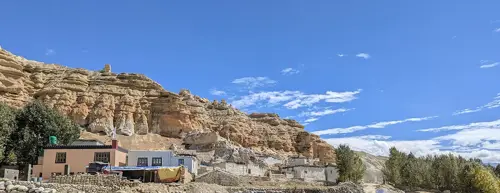
Upper Mustang is the gold standard for monsoon trekking in Nepal. Dry, warm, culturally extraordinary, and essentially crowd-free. You'll walk through a landscape that looks like the Tibetan plateau — red-ochre cliffs, ancient cave monasteries, medieval walled villages — while the rest of Nepal is under cloud cover.
Why it works in monsoon:
Protected by the Annapurna-Dhaulagiri wall. Clear mornings almost guaranteed. The Tiji Festival in May and the Yartung Festival in July-August add cultural depth no other season offers.
Duration: 10–14 days from Pokhara
Permit required: Restricted Area Permit (RAP) — USD 500 for 10 days + ACAP (USD 23). Must book through a TAAN-registered agency such as Trek Me Nepal.
Trek Me Nepal Offer
We handle Upper Mustang RAP and ACAP permits, guide, lodge, and transport from Pokhara. Monsoon-season packages from USD 1,200 for 10 days. Contact us to check availability for June–August 2026.
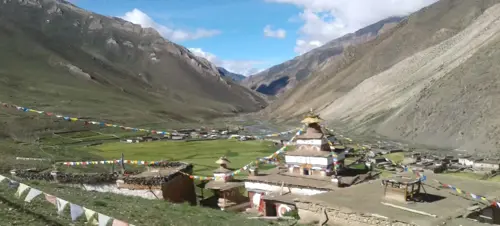
Upper Dolpo is one of the most remote and spectacular regions in Nepal. The rain shadow conditions apply fully here. You will share the trail with almost no one — even outside monsoon, Dolpo sees a fraction of the visitors that Everest and Annapurna attract.
Why it works in monsoon: Tibetan-plateau landscape, virtually zero rainfall, extraordinary Buddhist culture around Shey Phoksundo Lake.
Important note: Logistically demanding. Requires a domestic flight to Juphal, full camping gear, and serious advance planning. Best booked at least 2 months ahead.
Permit required: Upper Dolpo RAP (USD 500 for 10 days) + Shey-Phoksundo National Park permit.
Protected by the surrounding Manaslu-region peaks, Tsum Valley receives significantly less monsoon rain than the main Manaslu corridor. Ancient Buddhist monasteries, culturally intact Tibetan villages, and very few visitors year-round make this one of Nepal's best-kept secrets.
Duration: 14–18 days from Kathmandu
Permit required: Tsum Valley Restricted Area Permit — USD 35 per week. Also requires Manaslu Conservation Area Permit.
Poon Hill (2 days) — Short enough to manage between rain spells. Dramatic cloud formations. Leeches on lower sections.
Mardi Himal Base Camp — Possible from September as monsoon fades. Wildflowers in bloom. Muddy below 3,000m.
Chisapani–Nagarkot — Close to Kathmandu, 3–4 days. Good for acclimatization and a test run in wet weather.
High-Risk During Monsoon Season The following routes carry genuine risk between June and August: Everest Base Camp (heavy rain, poor visibility, Lukla flights frequently cancelled), Annapurna Circuit (Thorong La pass dangerous with snow and rain), Langtang Valley (trail damage, landslides, river crossings), Manaslu Circuit (route damage from landslides, dangerous river crossings). These are spectacular treks — but book them for October or April instead. |
June: Best Monsoon Window The first 10 days of June often offer the clearest conditions of the entire monsoon period — the rains have not yet fully established. Upper Mustang is at its best. Prices begin dropping. Book rain-shadow treks here for optimal conditions. | July–August: Peak Monsoon Heaviest rainfall across the south. Rain-shadow zones fully viable. Temperature sweet spot in northern valleys: 15–25°C days, 5–10°C nights above 3,500m. Tiji and Yartung festivals in Upper Mustang. Wildflowers peak. |
One of the most compelling reasons to trek in monsoon is cost. Because the season is considered off-peak, both lodge rates and agency package prices drop significantly compared to spring and autumn.
Package | Peak Season Price | Monsoon Price | Saving |
Upper Mustang 10 days | USD 1,700 – 2,000 | USD 1,200 – 1,500 | ~30% |
Annapurna Poon Hill 4 days | USD 450 – 550 | USD 300 – 380 | ~35% |
Tsum Valley 16 days | USD 2,200 – 2,600 | USD 1,500 – 1,900 | ~35% |
EBC Helicopter Return 12 days | USD 3,200 – 3,800 | NOT recommended in monsoon | — |
Zero permit wait times, fewer trekkers on the trail, and more personalized attention from your guide are additional advantages the peak-season crowd never experiences.
Waterproof jacket and trousers — full rain gear, not a light shell
Gaiters — mandatory for lower-elevation trails to manage leeches and mud
Leech socks — tight-woven, worn under regular socks on trails below 2,500m
Dry bags or pack liner — keep everything inside your pack completely dry
Quick-dry clothing — no cotton; merino wool or synthetic only
Trekking poles — essential on wet, slippery trails
Water purification — iodine tablets or Steripen; water sources multiply in monsoon
High-quality gaiters — specifically useful for Tsum Valley and Poon Hill
1. Always trek with a guide in monsoon. Book a licensed, TAAN-registered guide.
2. Monitor forecasts. Check weather forecasts daily — Nepal's Department of Hydrology and Meteorology provides 3-day mountain forecasts. Your guide will monitor these.
3. River crossings. Never cross swollen rivers without your guide's assessment. River levels change within hours during heavy rainfall.
4. Flight buffers. Domestic flights to Lukla, Jomsom, and Juphal experience high cancellation rates in monsoon. Build 1–2 buffer days into your itinerary for any flight-dependent trek.
5. Insurance. Purchase comprehensive travel insurance that explicitly covers monsoon-season trekking and helicopter rescue.
Leeches are common below 2,500m on southern-facing trails during June–August. They are harmless but unpleasant. The solution is simple: tight gaiters, leech socks, salt or insect repellent at trailhead stops. Check ankles and calves every hour on lower trails. The rain shadow zones (Upper Mustang, Dolpo) have essentially no leeches.
Bipin has worked in Nepal's trekking industry for over 18 years, leading expeditions across Everest, Annapurna, Manaslu, and the restricted areas of Upper Mustang and Dolpo in every season including monsoon. He holds trekking guide certifications from the Nepal Tourism Board and has completed wilderness first-aid training. Based in Kathmandu, Bipin leads Trek Me Nepal's operations team and designs custom itineraries for clients from over 30 countries.
We are a TAAN-registered agency based in Kathmandu specializing in customized trekking packages for all seasons. Our monsoon packages for Upper Mustang, Tsum Valley, and Dolpo are available from June through September 2026. We handle all permits, guides, lodging, and logistics — including the Restricted Area Permit application that must be filed through a licensed agency. Contact us at [email protected] to check availability and receive a custom quote.
Yes — with the right preparation, experienced guides, and correct route selection. Rain-shadow destinations like Upper Mustang and Dolpo are entirely safe and dry. Other regions require attention to landslide alerts and flexible itineraries.
Upper Mustang is consistently our top recommendation for June–August trekking. Langtang Valley and Upper Manang are excellent choices for trekkers comfortable with some rainfall.
Yes. Accommodation, permits, and domestic flights are significantly cheaper during the off-season. Many teahouses offer discounted rates, and restricted-area permits are immediately available without advance booking.
Leeches are present below 3,000m on forested trails, particularly in June–August. Leech socks and DEET-based repellent are effective. Above 3,000m, leeches are not a concern.
Check out recent travel trends and news by Trek me Nepal


More Reasons Why Travellers Trust Us



Bipin Thapa Magar
Guide of the Year | Operations Manager & Chief Planner | Trek Me NepalBipin Thapa Magar is a highly experienced trekking and expedition professional with over 20 years in Nepal’s adventure tourism industry. He began his journey in 2004 as a porter and gradually advanced... Read More