






Who We Are


Guide of the Year


Documents


Charity & SR


Latest Posts


Questions & Answers

The Manaslu Circuit Trek is a remote and culturally sensitive route in Nepal, circling Mount Manaslu (8,163m), the world’s eighth-highest peak.
Unlike more commercialized trails like Everest or Annapurna, Manaslu remains a restricted and protected zone, requiring trekkers to obtain mandatory permits to ensure environmental conservation, cultural preservation, and controlled tourism.
Environmental Protection: The trek passes through the Manaslu Conservation Area (MCAP) and Annapurna Conservation Area (ACAP), which are ecologically fragile. Permit fees directly fund conservation efforts, trail maintenance, and waste management.
Cultural Sensitivity: The region is home to Tibetan Buddhist communities, where unrestricted tourism could disrupt local traditions. Permits help regulate visitor numbers.
Legal Compliance: The Nepalese government designates Manaslu as a Restricted Area, meaning independent trekking is prohibited. Violators face fines, deportation, or trek termination.
Restricted Area Permit (RAP): Required for the Manaslu Restricted Area Permit (Manaslu RAP) and Tsum Valley Restricted Area Permit. These zones have strict entry controls due to their proximity to the Tibetan border and cultural significance.
Conservation Area Permits (MCAP/ACAP): Cover environmental protection in the Manaslu Conservation Area and overlapping sections of the Annapurna Conservation Area.
Limit Overcrowding: A fixed number of permits is issued per season, reducing environmental strain.
Support Local Economies: Permit fees fund community projects, schools, and healthcare in rural villages.
Safety Enforcement: Permits require trekkers to use licensed guides and travel in groups of at least two, ensuring emergency support in this remote region.
Without proper permits, trekkers risk being turned back at checkpoints (e.g., Jagat, Dharapani, or Samdo), where officials verify documents. Compliance ensures a seamless trek while contributing to the region’s sustainability.
Note: All permits for the Manaslu Circuit Trek can be arranged through Trek Me Nepal, ensuring full compliance with government regulations.
To trek the Manaslu Circuit legally, you must obtain several permits, each serving a distinct purpose based on the region’s conservation status and government regulations. Below is a detailed breakdown of all mandatory permits, their coverage, and associated costs.
Purpose: Required for entry into the Manaslu Restricted Zone, a controlled area near the Tibet border with limited access to protect cultural and geopolitical sensitivities.
Validity: Issued for a specific duration (typically matching your trek itinerary).
Things to Note:
Non-negotiable requirement: Must be obtained through a registered trekking agency (individual applications are not accepted).
Checkpoints: Verified at Jagat, Samdo, and other police posts along the route.
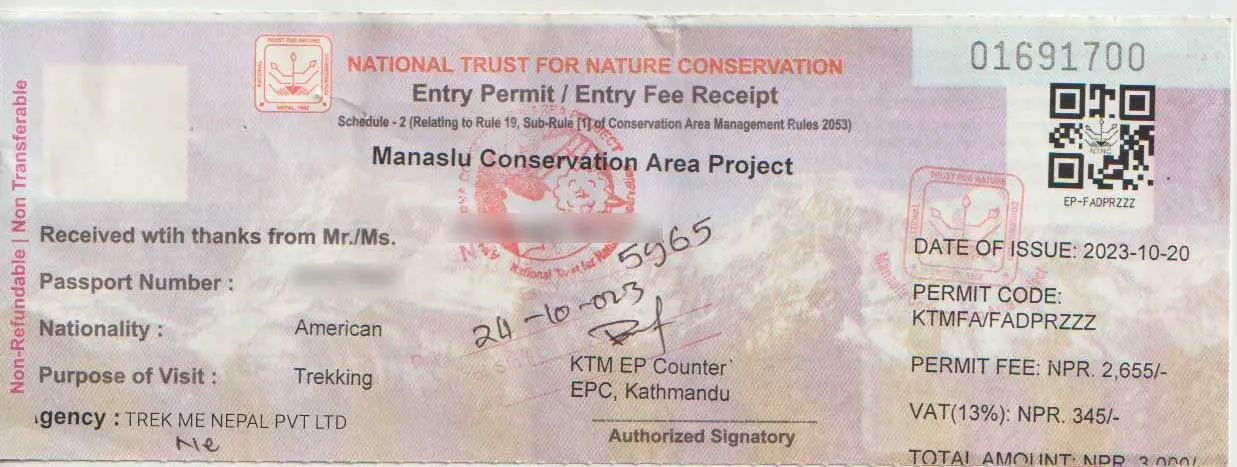
Purpose: Funds conservation efforts in the Manaslu Conservation Area, covering biodiversity protection and sustainable tourism initiatives.
Validity: Single-entry permit valid for the entire trek duration.
Things to Note:
Covers the entire Manaslu region, including villages like Samagaun and Lho.
Issued at the National Trust for Nature Conservation (NTNC) office in Kathmandu or Pokhara, or through registered agencies.
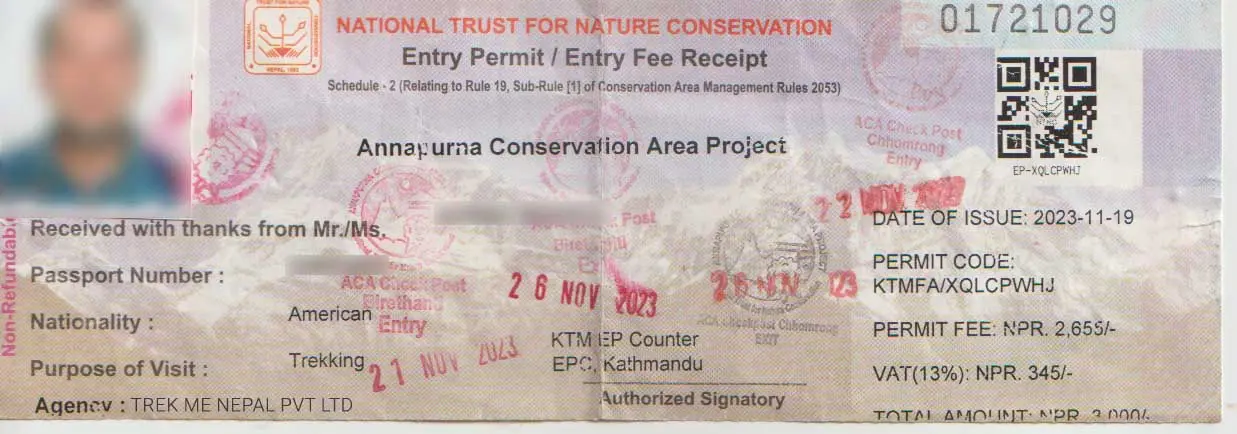
Annapurna Conservation Area Permit (ACAP)
Purpose: Required for the section of the Manaslu Circuit that overlaps with the Annapurna Conservation Area (e.g., Dharapani to Besishahar).
Validity: Single-entry permit valid for the duration of the trek.
Things to Note:
Often confused as optional, but mandatory if your trek exits via Besishahar (standard Manaslu Circuit route).
Can be obtained at the ACAP office in Kathmandu, Pokhara, or through agencies.
Purpose: Required only if adding the Tsum Valley detour, a culturally restricted zone with ancient Tibetan Buddhist villages.
Validity: Duration-specific, similar to MRAP.
Things to Note:
Issued alongside the MRAP but requires a separate fee.
Checkpoints: Strict enforcement at Lokpa and Chhekampar.
Purpose: A local permit introduced in recent years, funding rural infrastructure projects in the Chumnubri region (part of the Manaslu trek route).
Things to Note:
Often overlooked but increasingly enforced at checkpoints like Machhakhola.
It can be arranged by your trekking agency in Kathmandu.
Keep in Mind
All permits except ACAP must be arranged via a registered trekking agency (independent applications are not permitted for restricted zones).
Permit checks are strict: Missing any permit risks fines or expulsion from the trek.
Costs are non-refundable, so confirm your itinerary before applying.
Manaslu Restricted Area Permit (MRAP) | |||
Season | Duration | Cost (USD) | Cost (NPR) |
Peak (Sep-Nov, Mar-May) | First 7 days | $100 | ≈13,300 |
Each additional day | $15 | ≈2,000 | |
Off-Peak (Dec-Feb, Jun-Aug) | First 7 days | $75 | ≈10,000 |
Each additional day | $10 | ≈1,330 | |
Key Notes:
Mandatory for all trekkers.
Fees are per person; the minimum charge is for 7 days.
Must be arranged through a registered trekking agency.
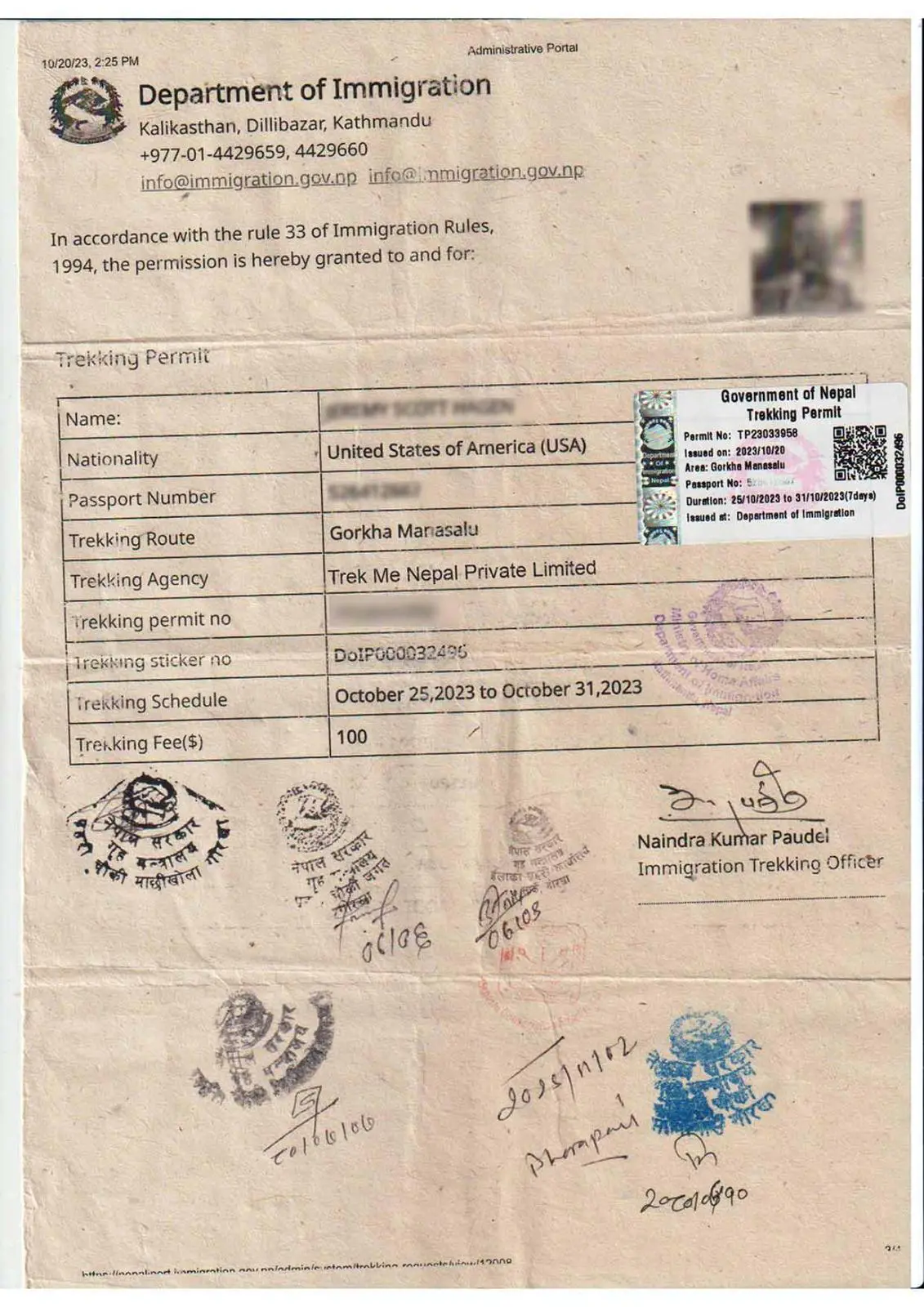
Category | Cost (NPR) | Cost (USD) | Validity |
Foreigners | 3,000 | ≈23 | Entire trek |
SAARC Nationals | 1,000 | ≈8 | Entire trek |
Key Notes:
Covers the Manaslu Conservation Area.
Obtainable at NTNC offices or through agencies.
Category | Cost (NPR) | Cost (USD) | Validity |
Foreigners | 3,000 | ≈23 | Entire trek |
SAARC Nationals | 1,000 | ≈8 | Entire trek |
Key Notes:
Required only if exiting via Besishahar.
No seasonal variation.
The Tsum Valley extension requires additional permits separate from standard Manaslu Circuit permits. This remote area has special protection due to its cultural significance and border proximity.
Season | Duration | Cost (USD) | Cost (NPR) |
Peak (Sep-Nov, Mar-May) | First 7 days | $40 | ≈5,300 |
Each additional day | $7 | ≈930 | |
Off-Peak (Dec-Feb, Jun-Aug) | First 7 days | $30 | ≈4,000 |
Each additional day | $7 | ≈930 |
Key Notes:
Add-on permit for Tsum Valley detours.
Separate from MRAP fees.
Category | Cost (NPR) | Cost (USD) | Validity |
All Trekkers | 2,000 | ≈15 | Entire trek |
Key Notes:
Enforced at checkpoints like Machhakhola.
Often included in agency packages.
What’s Covered by Permit Fees:
Entry rights to restricted/conservation areas.
Conservation and community development funds.
Basic trail maintenance and waste management.
What’s NOT Covered:
Guide/porter services (mandatory but paid separately).
TIMS card (not required for Manaslu).
Visa or insurance costs.
Minimum group size: 2 trekkers (solo travelers must join a group).
Mandatory costs:
Licensed guide fee: $25–$35 USD/day (paid directly to agency).
Porter (optional): $15–$20 USD/day.
Note: Permit fees are fixed per person; guide costs are additional.
Things to Remember:
Permits are non-negotiable and non-refundable.
Fees are per person, with no group discounts.
Pay in USD or NPR (rates fixed by Nepal government).
Registered agencies handle payments (no DIY option for restricted permits).
Obtaining the necessary permits for the Manaslu Circuit Trek involves specific procedures and authorized channels. Below is a comprehensive guide to acquiring all required permits through proper channels.
The Manaslu Restricted Area Permit (MRAP) and Tsum Valley Restricted Area Permit can only be obtained through government-registered trekking agencies in Nepal. These agencies must be:
Licensed by the Nepal Tourism Board (NTB)
Members of the Trekking Agencies' Association of Nepal (TAAN)
Authorized to operate in restricted areas
Key Points:
Individual trekkers cannot apply directly for restricted area permits
Agencies handle the entire application process on your behalf
They submit the required documents to the Department of Immigration
For conservation area permits (MCAP and ACAP), you have more options:
In Kathmandu:
Department of Immigration: For MRAP processing (via agency only)
National Trust for Nature Conservation (NTNC): For MCAP
ACAP Office: For Annapurna Conservation Area Permit
Tourist Service Center: For general permit inquiries
In Pokhara:
NTNC Office: For MCAP
ACAP Office: For Annapurna Conservation Area Permit
Processing Times
MRAP: 1 business day (through agency)
MCAP/ACAP: Immediate issuance during office hours
Location | Permits Available | Best For | Processing Time |
Kathmandu | All permits (via the agency for restricted permits) | Trekkers starting directly to Manaslu | 1 day for the full set |
Pokhara | Only MCAP and ACAP | Those acclimatizing in Pokhara first | Immediate |
Important Notes:
Restricted area permits (MRAP, Tsum) must start processing in Kathmandu
Conservation permits (MCAP, ACAP) can be obtained in either city
Pokhara options are limited to non-restricted area permits
All permits require:
Valid passport (minimum 6 months validity)
Nepal visa copy
Passport-sized photos (2 copies)
Completed application form
Trekking itinerary
Travel insurance proof
Agency confirmation letter (for restricted permits)
Special Requirements:
MRAP requires guide's license copy and agency registration documents
Tsum Valley permit needs additional route details
Choose Authorized Agency: Select a registered trekking company
Submit Documents: Provide all required paperwork to the agency
Payment: Pay permit fees to the agency (USD or NPR)
Agency Processing: They submit to the Department of Immigration
Collection: Agency collects permits (1-2 business days). Verification: Check all details are correct before the trek
Timeline Recommendations
Start the process at least 3 days before the trek departure
Allow extra time during peak seasons (March-May, September-November)
Physical permits will be issued on official government paper
Contains: QR code, trekker details, dates, and authorized zones
Verify that all information matches your passport exactly
The agency should provide copies before the trek departure
Checkpoint Procedures:
Original permits must be shown at all checkpoints
Checkpoints at Jagat, Deng, Samagaun, and Samdo
Authorities record permit details at each stop
The permits for the Manaslu Circuit Trek come with strict legal requirements set by the Nepalese government. Failure to comply can result in fines, expulsion from the trek, or legal action.
Rule: A minimum of 2 foreign trekkers is required to obtain the Manaslu Restricted Area Permit (MRAP).
Exception: Solo trekkers must join an existing group through a registered agency.
Verification: Checkpoints will confirm group size at Jagat, Samagaun, and other stops.
Reason:
Safety in remote areas
Reduced environmental impact
Requirement: All trekkers must hire a government-licensed guide registered with the Nepal Tourism Board.
Guide Qualifications:
Valid trekking guide license
First aid and altitude training
Registered with a legal trekking agency
Documentation: The guide must carry:
Their license copy
Trekkers' permit copies
Emergency contact details
Penalty: Trekking without a guide risks:
Immediate trek termination
NPR 20,000+ fine (≈$150 USD)
Possible deportation
Permits are verified at multiple checkpoints.
Checkpoint Location | Permits Verified | Additional Checks |
Jagat (entry point) | MRAP, MCAP | Group size, guide verification |
Deng | MRAP, MCAP | Passport matching |
Samagaun | MRAP, MCAP | Trekking Agency details |
Samdo (near the Tibet border) | MRAP | Special border zone clearance |
Dharapani (exit to Annapurna) | ACAP | Conservation fee validation |
Procedure at Checkpoints:
Present original permits + passport
Guide registers group details
Officials stamp/log permit numbers
Permit Validity:
Strictly valid only for specified trek dates (no extensions on trail).
Dates cannot be changed after issuance (new permit required).
Restricted Areas:
No deviation from approved route (e.g., no side trips to Tibet border).
Tsum Valley requires a separate permit even if adding mid-trek.
Environmental Rules:
No camping outside designated areas.
Strict no-littering policies (fines up to NPR 10,000).
The Nepalese government maintains strict policies regarding modifications to trekking permits. Understanding the regulations for extensions, refunds, and changes is essential for trekkers planning the Manaslu Circuit.
Extensions are only possible for the Manaslu Restricted Area Permit (MRAP) and Tsum Valley Permit, and must be processed before the original permit expires.
To extend a permit, your guide must first notify the registered trekking agency, which will then submit a formal request to the Department of Immigration in Kathmandu. The process takes 1-2 business days and requires payment of additional fees at the same daily rate as the initial permit.
Extensions are limited to a maximum of 7 additional days and are subject to approval. Conservation permits (MCAP and ACAP) cannot be extended under any circumstances, meaning trekkers would need to purchase new permits if their plans change.
It's important to note that no on-the-spot extensions are granted at trail checkpoints.
All permits for the Manaslu Circuit Trek are non-refundable once issued, with very few exceptions. Partial refunds may be available if a trek is cancelled before the permit has been issued, though agencies typically retain a processing fee.
In cases of government-ordered trail closures due to natural disasters or other emergencies, trekkers may receive prorated refunds for unused days, but this requires official documentation of the closure.
Medical emergencies may qualify for partial refunds (typically 50-80%) but require submission of hospital reports and other supporting documents to immigration authorities.
No refunds are provided for changes of mind after permit issuance, incomplete treks due to personal reasons like altitude sickness, or lost/damaged permits.
Changes to trek dates are possible before permit issuance with at least 72 hours notice and no additional fees. However, after permits have been issued, any changes to restricted area permits (MRAP and Tsum Valley) require purchasing new permits at full cost, as the original permits become invalid.
Conservation permits (MCAP and ACAP) may be reused if the new trek dates fall within the original validity period. Route modifications, such as adding Tsum Valley to an itinerary, always require a new permit application. Reducing the trek duration forfeits any unused days without refund.
Lost or damaged permits can be replaced by submitting a police report (for lost permits) and an official letter from the trekking agency explaining the circumstances. The replacement fee is NPR 5,000 (approximately $38 USD) per permit, and processing takes one business day in Kathmandu.
Damaged permits must be surrendered when applying for replacements. Trekkers should note that digital copies or photos of permits are not accepted at checkpoints, so physical copies must be carried at all times.
Planning trek dates carefully is crucial, as changes after permit issuance are costly and time-consuming. Travel insurance is highly recommended to cover non-refundable permit costs in case of unexpected changes.
Working with a licensed trekking agency like Trek Me Nepal ensures proper handling of administrative issues and compliance with all regulations.
Several misconceptions persist about Manaslu trekking permits.
Fact: The Manaslu Restricted Area requires:
Minimum 2 trekkers per group
Government-licensed guide at all times
Solo travelers must join existing groups through registered agencies.
Fact: The Trekkers' Information Management System (TIMS) card:
Not valid for Manaslu Restricted Area
Separate MRAP/MCAP permits remain mandatory
Only applies to non-restricted trekking regions
Fact: While permit costs are lower, December-August:
Same documentation required
Identical group/guide regulations apply
Checkpoints remain operational year-round
Red flags include:
Offers to bypass permit requirements
Prices significantly below standard rates
No TAAN/NTB registration number
Note: Trek Me Nepal holds valid NTB/TAAN accreditation for transparent permit processing.
No. The Restricted Area Permit requires a minimum of 2 trekkers and a licensed guide at all times. Solo travelers must join a group.
No. Restricted Area permits must be processed physically through registered agencies in Kathmandu. Only conservation permits (MCAP/ACAP) can be obtained at NTB offices.
You must file a police report and pay NPR 5,000 per permit for replacement through your agency. Digital copies aren't accepted at checkpoints.
At every major checkpoint (Jagat, Deng, Samagaun, Samdo). Officials verify permits, passport details, and guide credentials.
Only Restricted Area permits (MRAP/Tsum) can be extended, requiring agency processing in Kathmandu before expiration. Conservation permits cannot be extended.
Minimum NPR 25,000 fine, immediate trek termination, and possible deportation. Checkpoints strictly enforce regulations.
No. All permits are non-refundable after issuance, except for government-ordered trail closures with official documentation.
At least 3 working days before trek departure. During peak seasons (September-November, March-May), allow 5-7 business days for processing.
Yes. All trekkers, regardless of age, require full permits at standard rates.
Check out recent travel trends and news by Trek me Nepal


More Reasons Why Travellers Trust Us







Bipin Thapa Magar
Guide of the Year | Operations Manager & Chief Planner | Trek Me NepalBipin Thapa Magar is a highly experienced trekking and expedition professional with over 20 years in Nepal’s adventure tourism industry. He began his journey in 2004 as a porter and gradually advanced... Read More