






Who We Are


Guide of the Year


Documents


Charity & SR


Latest Posts


Questions & Answers

Tihar, also known as Deepawali, is one of the most widely celebrated festivals in Nepal. It is a five-day Hindu festival that occurs annually in the autumn months, typically October or November.
The festival is popularly referred to as the Festival of Lights in Nepal, because of the practice of illuminating homes, courtyards, and streets with countless oil-fed clay lamps (diyas), candles, and decorative electric lights.
The core of Tihar revolves around the themes of gratitude, unity, and the victory of light over darkness. It is a time when Nepalese express their gratitude to the gods, and the animals and elements of nature that play a vital role in their daily lives and culture.
Each of the five days is dedicated to a specific god, animal or element.
| Aspect | Key Details |
| What is it? | A 5-day Hindu festival in Nepal, also known as the "Festival of Lights." |
| When is it? | Annually in October/November (dates change based on the lunar calendar). |
| Main Significance | Expressing gratitude to gods, animals, nature, and strengthening family bonds. |
| The 5 Days | 1. Kaag Tihar: Crow worship 2. Kukur Tihar: Dog worship 3. Gai Tihar & Laxmi Puja: Cow and Goddess of Wealth worship 4. Govardhan Puja: Ox worship or Self-worship (Mha Puja) 5. Bhai Tika: Brothers honored by sisters |
| Key Traditions | Lighting oil lamps (diyas), making rangoli, Deusi/Bhailo songs, family feasts, gambling games. |
| For Tourists | Observe rituals respectfully, listen to festive songs, try sweets (sel roti), photograph decorations, visit local markets. |
| Best Time to Visit | October-November. Plan well in advance as it's peak season. |
| Travel Tip | Tours can be customized to include trekking and festival experiences for a complete trip. |
The festival is distinct from Diwali as celebrated in India, with unique rituals and a different sequence of days. While both are 'Festivals of Lights', Tihar's practices, such as the specific worship of crows, dogs, and cows on consecutive days, and the culminating brother-sister day of Bhai Tika, are characteristic of Nepalese culture.
The celebrations foster strong family bonding and community interaction, with activities like door-to-door singing (Deusi and Bhailo) and the creation of vibrant rangoli art at the entrances of homes.
A unique aspect of Tihar is the worship of animals. It is one of the few festivals in the world where certain animals are considered sacred, and honored with ceremonial garlands, ritual marks on their foreheads (tika), and special food offerings.
This practice highlights the harmonious relationship between humans and nature in Nepalese belief systems.
The origins of Tihar trace back to centuries-old Hindu traditions and mythology. Unlike many historical events with fixed dates, the genesis of Tihar is found in a collection of legends and evolving cultural practices that have been passed down through generations.
One of the primary legends associated with Tihar comes from the Hindu epic, the Mahabharata. The story centers on a queen named Draupadi.
It is believed that during the time the Pandavas, including Draupadi, were in exile, she found herself in a precarious situation without light in her dwelling.
To solve this, she prayed to Lord Krishna, who instructed her to light multiple oil lamps. When she did so, her home was filled with a divine, unwavering light, which is symbolically recreated during Tihar by lighting diyas and candles.
Another significant legend explains the tradition of worshipping the Goddess Laxmi. According to the myth, the goddess of wealth is nomadic and travels the world.
On the night of Laxmi Puja, she descends to Earth and visits the cleanest, brightest, and most welcoming homes.
To attract her blessings of prosperity for the coming year, people clean their homes, draw intricate rangoli at their entrances as a welcome mat, and light countless lamps to guide her inside. This ritual is a direct enactment of this ancient story.
The tradition of Bhai Tika, the day dedicated to brothers and sisters, also has a mythological basis. A popular tale tells of a sister who, upon learning that the god of death, Yamraj, was coming to take her brother's life, bravely stopped him.
She negotiated with Yamraj, insisting she would not allow him to take her brother until she finished performing a special ceremony for his long life.
She created a protective barrier with flowers, oil, and colored tika, and laid out a feast. Impressed by her devotion and cunning, Yamraj granted her brother immortality.
This act is commemorated every year during Bhai Tika, where sisters perform a similar ritual to ensure the long life and safety of their brothers.
The evolution of Tihar over the centuries has seen it become a cornerstone of Nepalese identity. Its practices have been influenced by the various ethnic communities across the country, such as the Newas, who incorporate their own rituals like Mha Puja (worship of the self) on the fourth day.
The festival's structure, emphasizing the veneration of animals like crows, dogs, and cows, reflects the agrarian history and the deep respect for nature within Nepalese society.
This historical context shows how Tihar is not a static festival but a living tradition that has absorbed and retained cultural significance from different eras and communities in Nepal.
The importance of the Tihar festival in Nepal extends far beyond its visual spectacle of lights and decorations. It has a profound spiritual and cultural significance that forms a core part of the national identity.
The festival is a comprehensive expression of gratitude, a reinforcement of social bonds, and a celebration of life itself.
Spiritually, Tihar is a period of purification and renewal. The meticulous cleaning of homes and the lighting of lamps are acts symbolizing the inner cleansing of the soul and the dispelling of ignorance, inviting positive energy and divine blessings into one's life.
The worship of Goddess Laxmi is central to this, as it is believed that her blessings bring not just material wealth, but also spiritual prosperity and well-being for the household.
Culturally, the festival serves as a powerful force for unity and family bonding. It is a mandatory time for family members to return to their ancestral homes, regardless of their distance. The rituals are designed to be collective activities.
For example, families create rangoli designs together, cook traditional sweets collectively, and children and elders go out in groups for Deusi and Bhailo. This collective participation strengthens intergenerational ties and reinforces a shared cultural heritage.
A key aspect of Tihar's importance lies in its practice of showing gratitude towards animals and nature. The veneration of crows, dogs, and cows is a cultural acknowledgment of the symbiotic relationship between humans and the natural world.
The crow is honored as a messenger, the dog for its loyalty and protection, and the cow for its sustenance and agricultural contribution. This practice instills a deep-seated respect for all living beings, a value that is central to Nepalese culture.
The culmination of the festival on Bhai Tika day underscores the importance of familial love and duty. The ritual is a powerful reaffirmation of the sacred bond between brothers and sisters.
It is a day dedicated solely to honoring this relationship, where sisters pray for the long life and success of their brothers, and brothers, in turn, pledge their lifelong support and protection.
This ceremony cements family structures and ensures that these vital relationships are celebrated and maintained.
For communities, Tihar fosters a strong sense of belonging and shared joy. The tradition of Deusi and Bhailo, where groups visit homes singing blessings, is not just a means of collecting gifts but a vibrant form of community interaction.
It brings people together, spreads festive cheer across neighborhoods, and ensures that the celebration is a collective, shared experience, bridging social and economic divides.
The Tihar festival is celebrated over five consecutive days, each with its own symbolism, and focus. This sequential celebration moves from the veneration of animals to gods and ends in the celebration of human relationships.
| Day | Celebration | A.D. Date | B.S. Date (2082) | Key Rituals |
| Day 1 | Kaag Tihar (Crow Day) | Sunday, October 19 | Kartik 2 | Crows are worshipped with offerings of food to avert grief and misfortune. |
| Day 2 | Kukur Tihar (Dog Day) | Monday, October 20 | Kartik 3 | Dogs are honored with garlands and a tika on their foreheads for their loyalty. |
| Day 3 | Gai Tihar and Laxmi Puja (Cow and Goddess of Wealth Day) | Monday, October 20* | Kartik 3 | Cows are worshipped in the morning. In the evening, homes are lit with diyas and candles to welcome Goddess Laxmi. |
| Day 4 | Govardhan Puja (Ox Day) / Mha Puja (Newa New Year) | Wednesday, October 22 | Kartik 5 | Oxen are worshipped, or the Newar community performs self-worship (Mha Puja). |
| Day 5 | Bhai Tika (Brother-Sister Day) | Thursday, October 23 | Kartik 6 | Sisters perform a ceremony for their brothers, applying a seven-colored tika and praying for their long life and prosperity. |
*Note: As the celebrations follow the lunar Tithi calendar, the dates can sometimes overlap in the regular calendar. This year, according to the official dates, Kukur Tihar and Laxmi Puja are both on October 20.
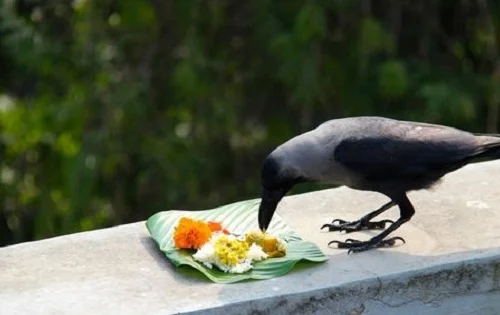
The first day of Tihar is dedicated to the crow, or kaag. In Hindu mythology, crows are considered messengers and are associated with sorrow and grief.
It is believed that crows carry messages to the realm of the dead. The rituals of Kaag Tihar are performed to appease these birds and avert any impending sadness or misfortune from the household.
Early in the morning, Nepalese households prepare a special offering for the crows. This typically consists of a thali (a plate) or a leaf platter filled with rice, sweets, and bread.
The offering is placed on the ground outside the home, often on the roof or in the courtyard, for the crows to consume.
By worshipping the crow and ensuring it is fed, people hope to please the messenger and prevent it from bringing bad news or grief in the coming year.
This day sets the tone for the festival, emphasizing gratitude and the importance of all living beings in the cosmic order.
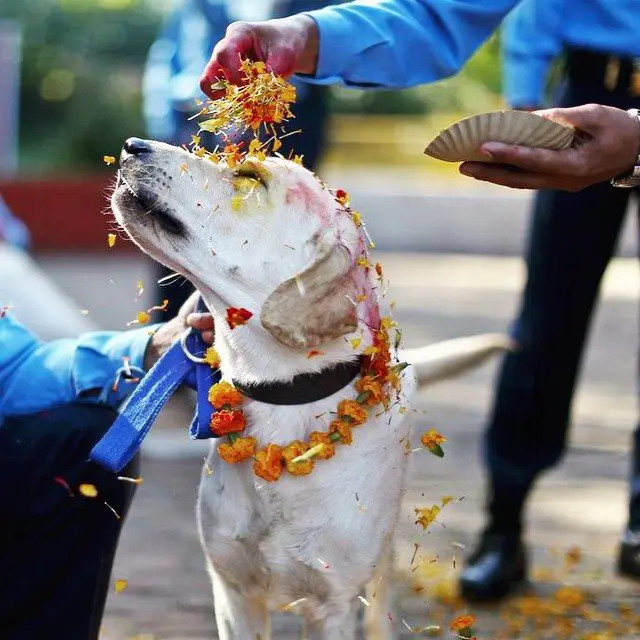
The second day, Kukur Tihar, is dedicated to honoring dogs, which are revered for their loyalty, guardianship, and the deep bond they share with humans.
According to Hindu belief, dogs are considered the vehicle of Bhairava, a manifestation of Lord Shiva, and are also the guardians of the underworld.
On this day, all dogs, regardless of their breed or ownership status, are honored. The central rituals involve adorning dogs with a floral garland, known as a mala, around their neck.
A ceremonial mark, a tika, is applied to their forehead using a mixture of red vermillion, yogurt, and rice. This mark is a sign of reverence and blessing.
The dogs are also offered a special, delicious meal, often including meat, eggs, and high-quality dog food. This celebration highlights the cultural uniqueness of Nepal, where the human-animal bond is formally recognized and celebrated in a religious context.
The third day is a major day of celebration with two focuses: cow worship in the morning and Goddess Laxmi worship in the evening.
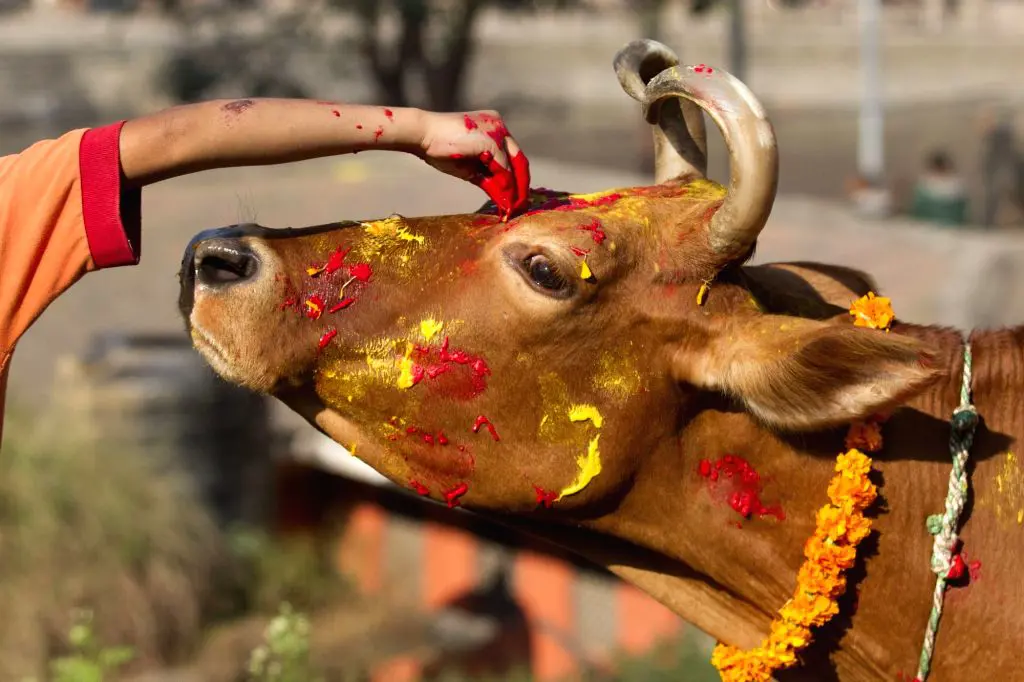
Gai Tihar: The cow is worshipped as a sacred symbol of wealth, prosperity, and motherhood in Hinduism. It is respected for its role in agriculture and for providing life-sustaining milk.
Similar to the dogs, cows are decorated with garlands and a tika is applied to their foreheads. They are fed a special meal, often including fresh grass, fruits, and sel roti (a traditional Nepalese ring-shaped rice doughnut).
In some rural communities, a full procession of decorated cows may take place.
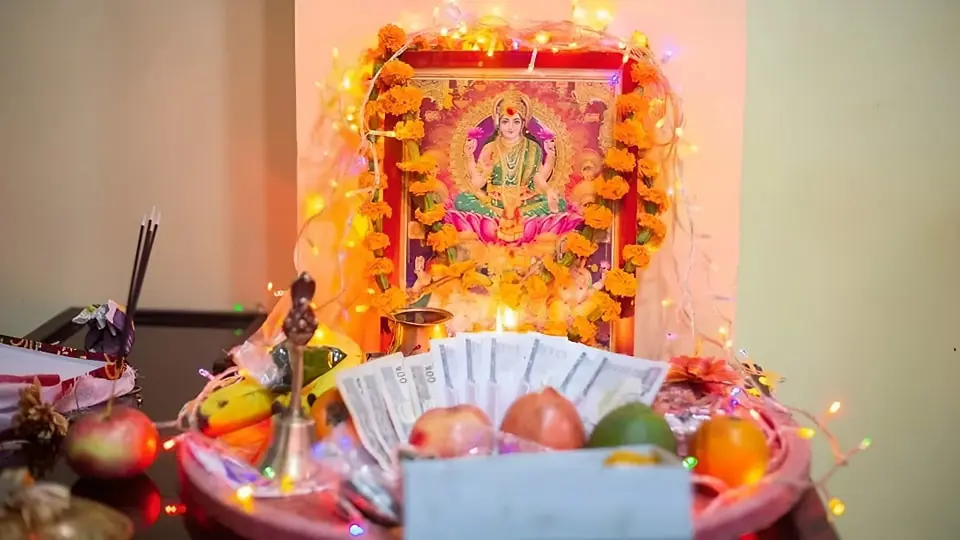
Laxmi Puja: As evening falls, the focus shifts to the worship of Goddess Laxmi, the deity of wealth and fortune. This is the core night of the Festival of Lights. Homes and businesses are meticulously cleaned beforehand.
Intricate and colorful patterns, known as rangoli, are created at the entrance of homes using colored powders, sand, and flowers to welcome the goddess
The most significant ritual involves lighting the entire premises with oil-filled diyas (clay lamps) and candles. It is believed that Goddess Laxmi will only enter a home that is clean, brightly lit, and inviting.
Families gather to perform the puja (prayer ceremony), offering prayers, flowers, sweets, and coins to the goddess, seeking her blessings for prosperity in the year ahead.
The night skyline of cities like Kathmandu and Pokhara is transformed into a shimmering sea of lights.
The observances on the fourth day vary based on cultural and community backgrounds.
For many, this day is dedicated to the ox, which, like the cow, is a vital animal in traditional farming and agriculture. Oxen are worshipped with garlands and tika in gratitude for their labor.
For the Newa community in Nepal, this day is observed as Mha Puja, or "worship of the self." This unique ritual involves a detailed ceremony where each family member sits before a special mandala (a symbolic circular diagram) and is worshipped individually.
The ritual signifies respect for one's own body and soul, acknowledging the divine within oneself, and praying for purification, prosperity, and long life. This day also marks the first day of the Nepal Sambat calendar, the Newari New Year.
Another ritual performed by some communities is the building of a small hill of cow dung, representing Govardhan Hill, which Lord Krishna lifted to protect villagers from torrential rains.
The fifth and final day of Tihar is Bhai Tika, a day dedicated solely to celebrating the bond between brothers and sisters. This is an emotional celebration for families across Nepal.
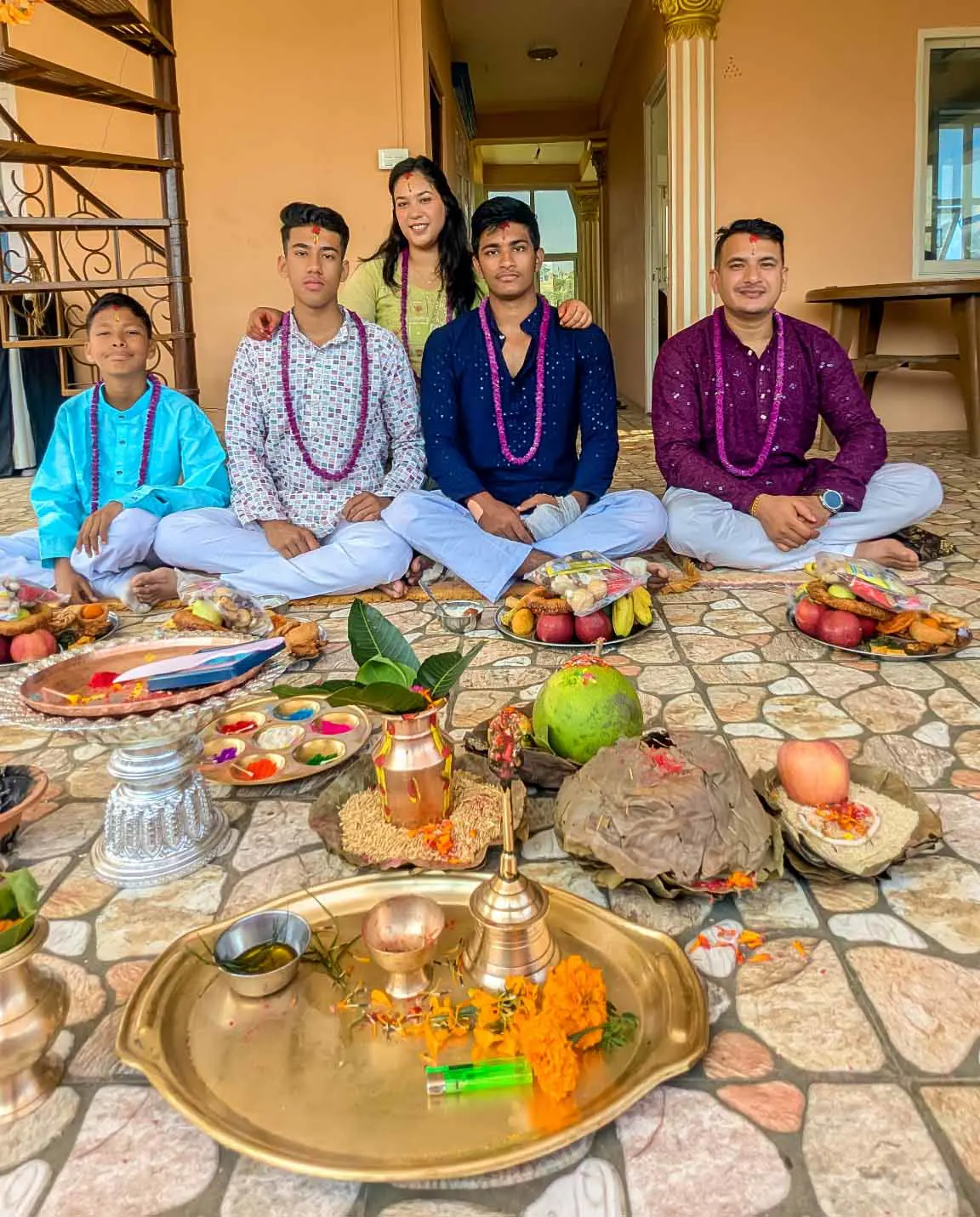
Sisters perform a detailed and elaborate ritual for their brothers. The brother sits on the floor, and the sister creates a protective barrier by circling him with oil, a special thread, and then flowers.
She then applies a long, vertical tika on his forehead, which is made of seven colors (saptarangi tika). This is followed by the offering of sweets, fruits, and nuts.
During the ceremony, the sister prays to Yamraj, the god of death, for the long life, health, and prosperity of her brother.
In return, the brother gives gifts to his sister and makes a vow to protect and support her throughout her life. The exchange of gifts and blessings reinforces the sacredness of this familial bond.
Even brothers and sisters who live far apart make an effort to be together for this ceremony, making it a powerful expression of love, loyalty, and family unity that brings the five-day festival to a close.
Deusi and Bhailo are traditional, folkloric songs that form a core part of the Tihar celebration, representing a vibrant and lively form of community interaction. These door-to-door musical performances are a means of spreading festive blessings and joy throughout neighborhoods.
The tradition is characterized by its group performances. Bhailo is typically sung by groups of women and girls, while Deusi is performed by groups of men and boys.
These groups, which can range from small family-based parties to larger community-organized troops, visit homes in their locality after the day of Laxmi Puja, primarily on the third and fourth nights of Tihar.
The performance involves the group singing traditional verses, often with call-and-response patterns, at the entrance of a home. The songs are prayers and blessings for the prosperity, good health, and longevity of the household members.
They often praise the Goddess Laxmi and express good wishes for the family's fortune. The musical accompaniment is usually provided by traditional instruments like the madal (a Nepali hand drum), and sometimes cymbals.
In return for their musical blessings, the home-owners give offerings to the singers. These offerings, known as Dakshina, can include money, fruits, rice, bread, and traditional sweets like sel roti.
The collected offerings are often used for a communal feast or for a social cause, further emphasizing the collective spirit.
The content of the songs can vary. While traditional verses are passed down through generations, it is also common for groups to incorporate modern, improvised lyrics that comment on contemporary social issues or include humorous elements, making the tradition dynamic and evolving.
From a tourist's perspective, witnessing or respectfully observing Deusi and Bhailo provides a direct insight into Nepalese community life. The experience is most vibrant in the older neighborhoods of cities like Kathmandu and Patan, and in the smaller towns and villages across the country.
The nights are filled with the rhythmic beat of the madal and the harmonious singing, creating an immersive and authentic cultural atmosphere. It is considered polite for observers to appreciate the performance from a slight distance and to seek permission before photographing or filming the groups.
During the Tihar festival, a unique and culturally accepted practice is the open participation in gambling and traditional games. This activity, which is otherwise restricted or frowned upon during the rest of the year, is considered a festive tradition and is socially permitted during these days, particularly on the night of Laxmi Puja.
The most common traditional card game played is known as Kauda or Langur Burja. It is a dice game, not cards, despite the "gambling" keyword often associating it with card games.
The game is played with a special rectangular board with different compartments and six cowrie shells which are used as dice.
Players place small bets, and the cowrie shells are rolled to determine the outcome. The game is primarily played for fun and small stakes, rather than for significant financial gain.
The cultural significance of this practice is deeply rooted in legend. It is believed that on the night of Laxmi Puja, the goddess herself engages in gambling.
Therefore, playing games of chance is seen as a way to emulate her and attract her favor, with winning considered an auspicious sign of good luck and prosperity for the coming year.
Beyond this spiritual belief, the social aspect is paramount. These games are played in gatherings among family and friends, often in a lighthearted and cheerful atmosphere.
They serve as a means of social bonding, breaking from routine, and adding an element of playful excitement to the festival.
For tourists witnessing or being invited to participate, it is important to understand the context. The activity is a cultural and social ritual, not a commercial gambling enterprise. Participation should be approached with a sense of respect for the tradition and its boundaries.
It is advisable to engage only in a friendly manner, with very small, symbolic stakes, and always within a private, social setting among trusted hosts.
The primary focus should be on the social interaction and cultural experience, rather than on the financial aspect of the game.
The Sakhiya dance is a traditional cultural performance specific to the Tharu community, an indigenous group predominantly residing in the Terai region of Nepal.
This dance is performed during major festivals, including Tihar, and holds significant cultural importance for the Tharu people.
The performance is characterized by its distinctive circular formation. Dancers, traditionally men, form a circle and move in a synchronized, rhythmic pattern.
The dance steps are deliberate and often involve stomping and shuffling of the feet, creating a steady, percussive beat.
The movements are designed to be graceful yet powerful, often mimicking activities from daily life and the natural world, such as the sowing of seeds or the movements of animals.
The attire worn by the dancers is a key element of the visual spectacle. Men typically wear a dhoti (a long, wrapped garment) and a kurta (a long shirt), often complemented by a traditional waistcoat and a distinctive headdress.
The costumes are frequently colorful and reflect the traditional dress of the Tharu community.
Musical accompaniment for the Sakhiya dance is provided by a range of traditional instruments. The primary instrument is the madal, a cylindrical drum held horizontally and played with both hands.
This is often supported by the deep, resonant sound of the dholak (a larger barrel drum) and the high-pitched, rhythmic clash of cymbals known as jhyali or taal. The music is rhythmic and repetitive, setting the pace for the dancers' movements.
The cultural significance of the Sakhiya dance is multifaceted. It is performed as an offering to the gods and ancestors, seeking their blessings for good health, a bountiful harvest, and prosperity.
It also serves as a vital mechanism for community bonding and cultural preservation.
The dance brings together people of all ages, reinforcing social cohesion and ensuring the transmission of Tharu traditions to younger generations. The performance is a display of collective identity and cultural pride.
The dance is performed during specific times, coinciding with major festivals like Tihar, Dashain, and Maghi (the Tharu New Year). While the Tharu community is spread across the Terai, the dance has regional variations in steps, costumes, and musical styles between different Tharu sub-groups, such as the Rana Tharu and the Dangaura Tharu.
The visual transformation of homes and public spaces is a defining characteristic of the Tihar festival. The use of specific decorations and lights is not merely aesthetic; each element carries deep symbolic meaning and is integral to the rituals.
A prominent decorative art form during Tihar is the creation of Rangoli, known as Chowkpurana in some parts of Nepal. These are intricate, colorful patterns drawn on the ground at the entrances of homes, in courtyards, and in prayer rooms.
The primary purpose of these designs is to welcome the Goddess Laxmi and other deities, guiding them into the home.
The materials used are natural and readily available. The base is often white clay or rice paste, which provides a bright background.
The patterns are then filled in with colored powders, which are traditionally made from dried rice flour, turmeric (for yellow), vermillion (for red), burnt barley (for black), and other natural pigments. In contemporary practice, synthetic colored powders are also common.
Additional elements like red clay, flower petals, grains of rice, and whole lentils are often incorporated to add texture and symbolism.
The patterns are highly symbolic. Common motifs include geometric shapes, floral patterns, footprints of the goddess (symbolizing her arrival), depictions of lotus flowers (a symbol of purity and beauty), and representations of swastikas (an ancient symbol of good fortune).
The entire composition is a symbolic prayer for prosperity, protection, and the invitation of positive energy. The act of creating Rangoli is often a communal family activity, where different generations come together to design and execute the artwork, reinforcing family bonding.
The illumination of homes with diyas (oil lamps) and candles is the most iconic practice of Tihar, earning it the name "Festival of Lights." This practice is central to the rituals of Laxmi Puja but continues throughout the festival.
A diya is a small lamp, typically made from clay, though brass and other metals are also used. It is filled with oil or ghee (clarified butter), and a cotton wick is placed in it.
On the main night of Laxmi Puja, these diyas are lit and placed in every possible location around a property: on windowsills, staircases, balconies, gates, and in rows along pathways and rooftops. Candles are also used extensively to supplement the diyas.
The symbolism of this practice is multifaceted. On a spiritual level, the light symbolizes the victory of knowledge over ignorance and good over evil.
The specific purpose on Laxmi Puja is to create a brilliantly lit path to guide the Goddess Laxmi, who is believed to travel the Earth on this night, into the home.
A dark home is thought to be overlooked by the goddess. Therefore, the more lights a household displays, the greater the chance of attracting her blessings of wealth and prosperity.
The visual effect after sunset is beautiful. Entire cities and villages glow with the warm, flickering light of thousands of lamps. The ambiance is one of peace and collective celebration.
The night-time view of neighborhoods illuminated in this traditional manner offers a powerful and evocative experience, showcasing a practice that blends deep spiritual belief with stunning visual spectacle.
Planning a visit to Nepal to experience the Tihar festival requires consideration of its timing, which is based on the lunar calendar. The festival falls in the months of October and November, specifically during the new moon night of the Hindu month of Kartik.
For precise planning, the exact dates for Tihar shift each year. For example, in 2025, the festival is on 19 to 23 October.
This period is one of the best times to visit Nepal for tourism in general and coincides with the peak tourist season. The weather conditions are highly favorable.
The intense monsoon rains have completely ended, leaving the skies clear, the air fresh, and the visibility exceptional.
Daytime temperatures in the Kathmandu Valley and Pokhara are typically pleasant and mild, ideal for extensive sightseeing and outdoor activities, while the nights are crisp and cool. In the lower Terai region, the climate remains warmer.
The cultural timing is also great. Tihar occurs shortly after another major Nepalese festival, Dashain. This means the country is still in a festive mood, and visitors can experience a continuous period of rich cultural immersion.
The clear autumn weather provides perfect conditions for photography, with the vibrant colors of the rangoli, the glittering lights of the diyas, and the dramatic Himalayan backdrop in many locations appearing at their most vivid.
For travelers, it is essential to plan well in advance. This is a peak domestic travel period as Nepalese people return to their hometowns to celebrate with their families.
As a result, flights into Nepal and domestic transportation can be in high demand, and hotel accommodations in prime locations like Kathmandu, Patan, Bhaktapur, and Pokhara book up quickly. It is advisable to secure flights and lodging several months ahead of your intended travel dates.
Check out our blog on Weather in Nepal by Seasons here.
In terms of regional variation, celebrations in the three main cities of the Kathmandu Valley: Kathmandu, Patan, and Bhaktapur are particularly vibrant and elaborate, offering a concentrated cultural experience.
However, to witness community-based traditions like the Sakhiya dance, traveling to areas in the Terai region, such as Sauraha or Lumbini, is necessary.
Observing cultural etiquette is crucial; while the festivities are public, they are also family-oriented and religious. Tourists are encouraged to be respectful observers, ask for permission before photographing private rituals or people, and dress modestly, especially when near religious sites or family homes during puja ceremonies.
At Trek Me Nepal, you can easily plan your trekking trip during the October-November season, which is also when the Tihar festival happens. The weather is perfect for treks like Everest, Annapurna or Langtang, and you can finish your hike in time to experience the festival in cities like Kathmandu or Pokhara.
If you want to see Tihar as part of your trip, we can create a custom itinerary for you. We will arrange your trek and your festival visit, making sure you get to see the lights, decorations, and family rituals. We handle all the planning so you can enjoy both the mountains and the culture without any stress.
1. Observe the Daily Animal Veneration Rituals
2. Witness the Laxmi Puja Illuminations and Decorations
3. Listen to Deusi and Bhailo Songs
4. Taste Traditional Festive Sweets
5. Respectfully Observe Bhai Tika Ceremonies
6. Visit Local Markets for Festive Shopping
The Tihar festival is a comprehensive cultural event that encapsulates the core values of Nepalese society. Its celebration is a profound expression of unity and gratitude, extending from the divine to the natural world and deep into family structures.
The five-day sequence provides a structured yet deeply personal framework for this expression, moving from the veneration of animals like crows, dogs, and cows, acknowledging their role in daily life and cosmology, to the worship of the Goddess Laxmi for prosperity, and culminating in the reaffirmation of familial bonds on Bhai Tika.
Dahal, B. P. (2020). Society, Socialization and Social Order through the Hindu Festivals in Nepal. Global Journal of HUMAN-SOCIAL SCIENCE: C Sociology & Culture, 20(5), 19-29.
Trek Me Nepal Archives
Check out recent travel trends and news by Trek me Nepal


More Reasons Why Travellers Trust Us








Anweiti Upadhyay
Travel Content Writer
Upadhyay is a writer and journalist with a background in law, economics, and culture. Having worked with leading news portals in Nepal, she has an eye for detail and a curiosity about the world.As the... Read More